
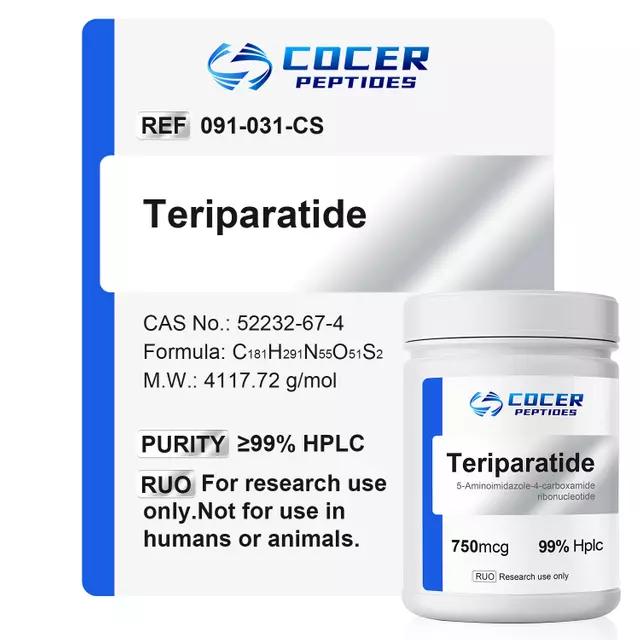
Teriparatide 20mg
Original price was: £55.00.£45.00Current price is: £45.00.
Teriparatide, a PTH analog, mimics natural PTH’s bone-building effects. It activates PTH1R, boosting osteoblast activity, increasing bone density, and improving bone structure. It also regulates calcium and phosphorus. Primarily used for severe osteoporosis, it significantly reduces fracture risk and treats other bone metabolism disorders.
Description
Teriparatide – Research-Grade Peptide for Bone Studies
Introduction
Cocer Peptides is proud to offer Teriparatide, a high-purity research-grade peptide representing the biologically active 1-34 N-terminal fragment of human parathyroid hormone (hPTH). With a molecular formula of C₁₈₁H₂₉₁N₅₅O₅₁S₂ and a molecular weight of 4117.72 g/mol, this 34-amino-acid peptide is of significant interest in research exploring bone formation mechanisms, osteoporosis pathophysiology, and skeletal tissue regeneration . First approved by the U.S. FDA in 2002 as a therapeutic agent for osteoporosis, teriparatide remains a benchmark compound for investigating anabolic bone pathways in laboratory settings .
⚠️ Important Notice: This product is supplied for laboratory research use only. It is not intended for human or veterinary consumption and must not be used in clinical or therapeutic applications.
As a research peptide, teriparatide provides scientists with a reliable tool for investigating osteoanabolic signalling pathways, bone remodelling dynamics, and potential therapeutic applications in bone regeneration. The compound is of particular interest to researchers studying the molecular mechanisms underlying intermittent PTH stimulation and its effects on osteoblast activity . The National Institutes of Health (NIH) maintains extensive databases on PTH research, and investigations into teriparatide continue to expand our understanding of bone biology . The broader field of peptide therapeutics has been documented in systematic reviews indexed on Google Scholar and ScienceDirect, highlighting the growing importance of peptide-based research tools .
What Is Teriparatide?
Teriparatide is a synthetic recombinant peptide comprising the first 34 amino acids of the endogenous human parathyroid hormone (PTH 1-34). The full-length parathyroid hormone consists of 84 amino acids, with the N-terminal region being responsible for biological activity . The peptide was developed as a research tool and therapeutic agent, demonstrating the ability to stimulate bone formation through intermittent exposure patterns .
The amino acid sequence of teriparatide includes key residues that contribute to its biological activity. Systematic mutational analysis using alanine scanning has identified residues Gly12, His14, Ser17, Arg20, and Leu24 as critical for anti-osteoporosis activity . Conversely, residues Gly13 and Gln30 showed increased activity when mutated, suggesting potential areas for peptide optimisation in research contexts . Research published in the Journal of Medicinal Chemistry and indexed on PubMed has explored the structure-activity relationships of teriparatide derivatives .
The peptide is available at a research-grade concentration in lyophilised solid form, designed for stability and ease of handling in controlled laboratory environments. Its molecular weight of 4117.72 g/mol positions it within the class of medium-length peptides capable of receptor-mediated signalling.
Chemical and Structural Properties
Molecular Characteristics
| Property | Specification |
|---|---|
| Product Name | Teriparatide |
| Molecular Formula | C₁₈₁H₂₉₁N₅₅O₅₁S₂ |
| Molecular Weight | 4117.72 g/mol |
| Sequence | PTH 1-34 (34 amino acids) |
| Purity | ≥98% (HPLC verified) |
| Form | Lyophilised Solid |
| Research Area | Bone Biology, Osteoporosis |
Teriparatide’s structure has been characterised through X-ray crystallography and molecular dynamics simulations. The three-dimensional structure was obtained from the Protein Data Bank (PDB ID: 1ZWA) and prepared at physiological pH for research applications . The peptide exhibits conformational flexibility, with secondary structure probabilities that are concentration-dependent .
The peptide is manufactured as a lyophilised solid, a drying process that preserves structural integrity and ensures stability during storage. This form allows researchers to reconstitute the peptide at desired concentrations for specific assay requirements.
Purity and Quality Standards
Teriparatide is manufactured to meet research-grade specifications with a guaranteed purity of ≥98% verified by High-Performance Liquid Chromatography (HPLC). This level of purity is essential for research applications where contaminant interference could compromise experimental validity.
Independent batch testing is conducted to verify:
-
Peptide identity and sequence confirmation
-
Purity verification via HPLC
-
Residual solvent analysis
-
Endotoxin testing (where applicable)
Researchers can access the Certificate of Analysis (COA) for each batch, providing full transparency on product quality and testing parameters.
Research Applications of Teriparatide
Bone Formation and Osteoporosis Research
The primary research interest in teriparatide centres on bone formation studies and osteoporosis models. As a PTH 1-34 analogue, teriparatide is studied for its potential influence on:
-
Osteoblast differentiation and activity
-
Trabecular bone architecture
-
Cortical bone remodelling
-
Bone mineral density modulation
Research into peptide regulation of bone formation remains an active area of investigation, with numerous studies indexed on PubMed and ResearchGate. The mechanism of action involves binding to PTH type 1 receptors (PTH1R) on osteoblasts and osteocytes, activating both Gs-mediated adenylate cyclase and Gq-mediated protein kinase C pathways . The anabolic effects of intermittent PTH exposure are mediated through upregulated expression of pro-osteoblastogenic growth factors including insulin-like growth factor 1 (IGF1) and fibroblast growth factor 2 (FGF2), as well as modulation of the Wnt/β-catenin signalling pathway by down-regulating the synthesis of the Wnt-antagonist sclerostin .
Intermittent exposure to teriparatide preferentially stimulates osteoblastic bone formation over osteoclastic resorption, creating what researchers term the “anabolic window” . This distinctive pharmacological feature distinguishes teriparatide from antiresorptive agents and makes it a valuable tool for investigating bone remodelling dynamics. Clinical research has demonstrated that daily teriparatide administration decreases the risk of vertebral fractures by 65% and nonvertebral fragility fractures by 53% in postmenopausal women with prior vertebral fracture . While these findings are from clinical contexts, they inform the research applications of the peptide in laboratory settings.
Bone Regeneration and Grafting Research
Teriparatide has demonstrated relevance in bone regeneration research and grafting studies . Preclinical investigations in ovariectomised rat models have shown that teriparatide plays a role in bone formation during the early stages of bone grafting, particularly when bone formation is inhibited . These findings suggest the peptide may be valuable for research into bone transplantation success and healing processes .
The peptide has also been investigated in the context of bone tissue engineering. Studies have explored gelatin/poly(lactic-co-glycolic acid)/attapulgite composite scaffolds equipped with teriparatide microspheres for osteogenesis research . These approaches demonstrate significant potential for bone tissue engineering applications, providing effective options for investigating bone regeneration and repair .
Cellular Signalling Pathway Investigation
Teriparatide serves as a research tool for cellular signalling pathway studies. The peptide’s anabolic activity is hypothesised to operate through specific receptor-mediated pathways, making it valuable for:
-
Mapping PTH1R signalling cascades
-
Investigating intermittent vs continuous exposure effects
-
Studying osteoblast differentiation mechanisms
-
Developing structure-activity relationship (SAR) models
The concept of pulsatile delivery has been explored to mimic the intermittent exposure pattern required for teriparatide’s anabolic effects . Research published in ScienceDirect has documented the development of programmable pulsatile delivery platforms using core-shell microspheres, highlighting the importance of temporal control in peptide signalling studies .
Aggregation Behaviour Studies
Teriparatide has been the subject of research into peptide aggregation behaviour, with implications for formulation stability and bioactivity . Molecular dynamics simulations have investigated the aggregation of teriparatide in aqueous media, revealing that self-association may lead to reduced efficacy and increased immunogenic risk . These studies are important for researchers investigating peptide stability and formulation strategies .
Recent research published in Scientific Reports and accessible via Nature has provided mechanistic insight into teriparatide aggregation, identifying hydrophobic and electrostatic interactions as key contributors . The findings offer guidance for minimising immunogenic risks in peptide-based therapeutics and are relevant for researchers developing stable peptide formulations .
Technical Specifications
| Specification | Detail |
|---|---|
| Product Name | Teriparatide |
| Molecular Weight | 4117.72 g/mol |
| Molecular Formula | C₁₈₁H₂₉₁N₅₅O₅₁S₂ |
| Sequence | PTH 1-34 (34 amino acids) |
| Purity | ≥98% (HPLC) |
| Form | Lyophilised Solid |
| Research Areas | Bone Biology, Osteoporosis |
| Storage | 2–8°C |
Reconstitution and Handling Protocol
Recommended Storage Conditions
Teriparatide is supplied as a lyophilised solid and should be stored at 2–8°C to maintain stability and potency. Proper temperature control prevents degradation and preserves the peptide’s structural integrity.
-
Short-term storage: 2–8°C (refrigeration)
-
Long-term storage: -20°C or below (freezer)
-
Protect from light: Store in original packaging or dark conditions
-
Do not freeze: After reconstitution, avoid repeated freeze-thaw cycles
Reconstitution Guidelines
For best results in a research setting, allow both the peptide and chosen solvent to reach ambient laboratory temperature before reconstitution. This helps maintain structural integrity during dissolution.
Standard reconstitution protocol:
-
Bring lyophilised peptide and solvent to room temperature
-
Add the appropriate volume of sterile solvent (water for injection, PBS, or bacteriostatic water)
-
Gently swirl—do not vortex or shake vigorously
-
Allow to fully dissolve before use
-
Use within the recommended timeframe
Dissolved solutions should be aliquoted and stored at -20°C to avoid repeated freeze-thaw cycles, and are best used fresh after preparation.
Quality Assurance and Testing
Cocer Peptides is committed to providing research-grade compounds that meet the highest standards of quality and consistency. Each batch of Teriparatide undergoes rigorous testing to verify:
-
Identity confirmation: Mass spectrometry verification
-
Purity analysis: HPLC with ≥98% purity threshold
-
Content uniformity: Consistency across vials
-
Residual solvent analysis: Within acceptable limits
Independent third-party testing is conducted to ensure unbiased verification. Researchers can view the Certificate of Analysis for their specific batch directly on our site, providing full transparency and traceability.
Frequently Asked Questions (FAQ)
What is Teriparatide?
Teriparatide is a synthetic recombinant peptide comprising the first 34 amino acids of human parathyroid hormone (PTH 1-34) . It is used in research investigating bone formation, osteoporosis mechanisms, and PTH signalling pathways.
What is the purity of Teriparatide?
Teriparatide is guaranteed to have a purity of ≥98% verified by HPLC testing. Each batch is independently tested to ensure quality and consistency.
How should Teriparatide be stored?
Teriparatide should be stored at 2–8°C as a lyophilised solid. After reconstitution, it should be refrigerated and used within the recommended timeframe to maintain stability.
What research applications is Teriparatide used for?
Teriparatide is used in research exploring bone formation, osteoporosis mechanisms, bone regeneration, cellular signalling pathways, and peptide aggregation behaviour .
How should I reconstitute Teriparatide?
Allow both the peptide and solvent to reach room temperature before reconstitution. Add the appropriate volume of sterile solvent and gently swirl to dissolve. Do not vortex or shake vigorously.
Is Teriparatide approved for human use?
No. Teriparatide is strictly for laboratory research use only and is not approved for human or veterinary use. This product must not be used in clinical or therapeutic applications.
Conclusion
Teriparatide (PTH 1-34) represents a valuable research tool for scientists investigating bone biology, osteoporosis mechanisms, and PTH signalling pathways. With a molecular weight of 4117.72 g/mol and guaranteed purity of ≥98%, this recombinant peptide offers the consistency and reliability required for reproducible research outcomes.
The peptide’s demonstrated effects in bone formation studies, bone regeneration research, and cellular signalling investigations make it a versatile tool for laboratory research. Research published in peer-reviewed journals and documented in the PubMed database has explored the biochemical properties and potential research applications of this peptide . The Google Scholar database provides access to thousands of citations on PTH and peptide research .
As with all research peptides, Teriparatide is intended for laboratory use only and should be handled according to established protocols for peptide-based research. Cocer Peptides is proud to provide UK researchers with access to high-quality, independently tested research compounds.
Related Research Products
-
Bioregulator Peptides – View our complete bioregulator collection
-
Certificate of Analysis – Access batch-specific COA data
-
Research Peptides – Explore our full peptide catalogue
-
Reconstitution Guide – Comprehensive handling protocols
-
Contact Us – For research support and enquiries
Disclaimer: This product is supplied for laboratory research use only. It is not intended for human or veterinary use and must not be used in any medical, therapeutic, or clinical applications. The information provided is for educational and research purposes only. Always follow standard laboratory safety protocols when handling research compounds.
Related products
-
Sale!

-
Sale!

-
Sale!

-
Sale!
Abaloparatide 3mg (1kit 10 vials)
Original price was: £55.00.£45.00Current price is: £45.00.
Reviews
There are no reviews yet.