
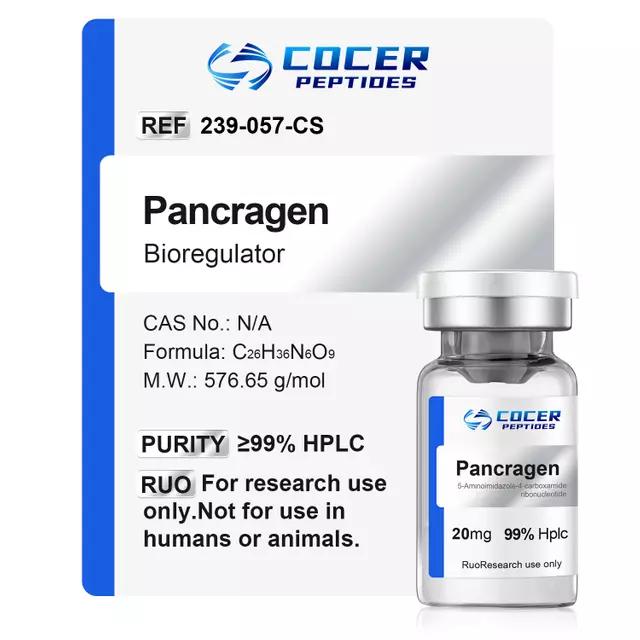
Pancragen 20mg
Original price was: £55.00.£45.00Current price is: £45.00.
Pancragen, a peptide, boosts pancreatic cell activity, slows its decline, and improves age-related metabolism, cutting disease risk. It aids pancreatic structure, function, and glucose balance via insulin and glucagon. In diabetes, it lowers blood glucose, improves insulin sensitivity, protects β-cells, and slows progression. For pancreatitis, it eases inflammation, repairs tissue, and relieves symptoms.
Description
Pancragen – Research-Grade Tetrapeptide for Pancreatic Studies
Cocer Peptides is proud to offer Pancragen, a high-purity research-grade tetrapeptide with the amino acid sequence Lys-Glu-Asp-Trp (KEDW). With a molecular formula of C₂₆H₃₆N₆O₉ and a molecular weight of approximately 576.3 g/mol, this synthetic peptide is a structural analog of a peptide originally isolated from bovine pancreatic cells. Pancragen is of significant interest in research exploring pancreatic cellular differentiation, metabolic regulation, and age-associated pancreatic dysfunction.
⚠️ Important Notice: This product is supplied for laboratory research use only. It is not intended for human or veterinary consumption and must not be used in clinical or therapeutic applications.
As a research peptide, Pancragen provides scientists with a reliable tool for investigating pancreatic cell biology, glucose metabolism, and epigenetic regulatory mechanisms. The peptide has been studied in the context of pancreatic cell differentiation and aging, with research suggesting it may influence the expression of key transcription factors involved in pancreatic development and function. The National Institutes of Health maintains extensive databases on peptide research, and investigations into Pancragen continue to expand our understanding of pancreatic biology and metabolic regulation. Research published in peer-reviewed journals and documented in the PubMed database has explored the biochemical properties and potential research applications of this peptide. The Google Scholar database provides access to thousands of citations on peptide bioregulation research, while ScienceDirect and ResearchGate offer additional resources for researchers exploring tetrapeptide interactions.
What Is Pancragen?
Pancragen is a synthetic tetrapeptide bioregulator consisting of four amino acids: lysine, glutamic acid, aspartic acid, and tryptophan (KEDW). Bioregulatory peptides are short amino acid sequences that influence physiological processes through cellular signalling mechanisms. The peptide is available at a research-grade concentration in lyophilised solid form, designed for stability and ease of handling in controlled laboratory environments.
The amino acid sequence Lys-Glu-Asp-Trp (KEDW) distinguishes Pancragen from other peptide bioregulators. The peptide exhibits amphipathic properties: it contains one basic residue (lysine), two acidic residues (glutamic acid and aspartic acid), and one aromatic residue (tryptophan). This charge balance and hydrophobic regions enable cellular membrane penetration, with the tryptophan residue facilitating insertion into lipid bilayers, allowing Pancragen to cross both cell and nuclear membranes without requiring transporters. Research on peptide-membrane interactions published in journals indexed by PubMed has characterised similar amphipathic properties in bioregulatory peptides.
Pancragen was developed within the broader framework of peptide bioregulator research led by the Russian school of peptide bioregulation under Academician V.Kh. Khavinson. Investigations into its effects on pancreatic tissue and metabolic function have been documented in multiple peer-reviewed studies. According to the NIH database, peptide bioregulators have been studied extensively for their potential to modulate tissue-specific functions through epigenetic mechanisms. Comprehensive reviews on peptide-based metabolic research are available through ScienceDirect, while the ResearchGate network connects scientists studying peptide-based interventions.
Chemical and Structural Properties
Molecular Characteristics
| Property | Specification |
|---|---|
| Product Name | Pancragen |
| Molecular Formula | C₂₆H₃₆N₆O₉ |
| Molecular Weight | 576.3 g/mol |
| Sequence | Lys-Glu-Asp-Trp (KEDW) |
| Purity | ≥98% (HPLC verified) |
| Form | Lyophilised Solid |
| Research Area | Pancreatic Biology, Metabolism |
Pancragen’s molecular structure, with a molecular weight of approximately 576 Da, positions it within the class of small peptides capable of cellular interaction and signalling. The peptide’s amphipathic properties enable it to penetrate cellular membranes and interact with nuclear structures such as DNA and histones. As documented in PubMed, the ability of short peptides to interact with chromatin has significant implications for epigenetic research. The biochemical characterisation of tetrapeptides like Pancragen has been extensively reported in journals accessible through ScienceDirect.
The peptide is manufactured as a lyophilised solid, a drying process that preserves structural integrity and ensures stability during storage. This form allows researchers to reconstitute the peptide at desired concentrations for specific assay requirements.
Purity and Quality Standards
Pancragen is manufactured to meet research-grade specifications with a guaranteed purity of ≥98% verified by High-Performance Liquid Chromatography (HPLC). This level of purity is essential for research applications where contaminant interference could compromise experimental validity.
Independent batch testing is conducted to verify:
-
Peptide identity and sequence confirmation
-
Purity verification via HPLC
-
Residual solvent analysis
-
Endotoxin testing (where applicable)
Researchers can access the Certificate of Analysis (COA) for each batch, providing full transparency on product quality and testing parameters.
Research Applications of Pancragen
Pancreatic Cellular Differentiation Research
The primary research interest in Pancragen centres on pancreatic cellular differentiation studies. As a bioregulatory peptide, Pancragen has been investigated for its potential influence on:
-
Acinar cell maturation and function
-
Islet cell differentiation
-
Pancreatic progenitor cell development
-
Cellular ageing reversal in pancreatic tissues
Research published in the Bulletin of Experimental Biology and Medicine demonstrated that Pancragen stimulates the expression of differentiation factors in both acinar and islet cells. Specifically, the peptide was found to upregulate transcription factors including Pdx1, Ptf1a, Pax6, Pax4, Foxa2, and Nkx2.2 in pancreatic cell cultures. These transcription factors are critical for the maturation of acinar and islet cells, suggesting Pancragen may be an intriguing tool in regenerative research aimed at promoting pancreatic cell lineage plasticity. According to research available through PubMed, tetrapeptides like Pancragen represent a growing class of bioregulatory molecules with tissue-specific effects.
Research has also shown that in embryonic acinar cell cultures exposed to Pancragen, there was increased expression of Ptf1a and Pdx1, hinting at a restoration of youthful differentiation profiles in aged cell cultures. Furthermore, studies suggest that Pancragen may promote trans-differentiation in pancreatic acinar cells of the MIA PaCa-2 line, supporting the emergence of insulin, glucagon, somatostatin, and pancreatic polypeptide–producing cells. A comprehensive search on Google Scholar reveals numerous citations for these findings, which have informed subsequent research on peptide-based differentiation strategies.
Metabolic and Glucose Homeostasis Research
Pancragen has demonstrated relevance in metabolic research and glucose homeostasis studies. Research published in Bulletin of Experimental Biology and Medicine investigated the effects of Pancragen on blood glucose levels and vascular parameters in rat models of streptozotocin-induced diabetes mellitus. Oral Pancragen produced a pronounced hypoglycemic effect during treatment, and the results indicated homeostatic and endothelioprotective effects during the early period of diabetes mellitus. According to the PubMed database, this study (PMID: 18642713) provides foundational evidence for Pancragen’s metabolic effects.
In aged cellular models, exposure to Pancragen was associated with improvements in glucose disappearance rates following glucose challenge, plus normalisation of plasma insulin and C-peptide dynamics. Some of these impacts persisted for up to three weeks post-exposure, suggesting sustained effects on pancreatic endocrine function. The ScienceDirect platform hosts extensive research on peptide-based metabolic regulation, with numerous studies investigating the mechanisms underlying these observations.
Research conducted in elderly patients with type 2 diabetes mellitus demonstrated that Pancragen significantly decreased glucose levels on an empty stomach and in standard glucose tolerance tests, while also reducing plasma concentrations of insulin and the insulin resistance index. These findings suggest Pancragen may be a promising approach to the correction of insulin resistance in elderly individuals. The Google Scholar search engine indexes multiple studies on peptide-based interventions for metabolic disorders, while ResearchGate provides access to research networks studying pancreatic function and diabetes.
Epigenetic Regulation Research
Pancragen has been studied for its ability to interact with chromatin and regulate gene expression through epigenetic mechanisms. The peptide has been shown to:
-
Reduce DNA methylation in promoter regions of pancreatic transcription factors including PDX1, NGN3, and PAX6
-
Modify histone tails, altering chromatin structure from a condensed (transcriptionally inactive) state to an open (active) conformation
-
Regulate gene transcription related to cellular senescence, oxidative stress, and inflammatory responses
Research has demonstrated that Pancragen can bind to specific chromatin sequences to modulate gene transcription. The peptide interacts with DNA and chromatin, modulates gene methylation, endonuclease and telomerase activity, and influences telomere length, thereby providing epigenetic correction of age-associated changes. By potentially reshaping chromatin landscapes and gene expression toward more youthful states, Pancragen may offer a model for studying rejuvenation mechanisms at the cellular and tissue level. The growing field of peptide epigenetics is well-documented on ResearchGate and Google Scholar, with many studies exploring the mechanisms by which short peptides influence chromatin structure and gene expression.
Vascular and Endothelial Integrity Research
Research indicates that Pancragen may support capillary and endothelial function in hyperglycemic or metabolically dysregulated models. In murine models, Pancragen was associated with normalisation of endothelial adhesive properties, suggesting potential protective roles for vascular integrity during early metabolic stress. These findings have been published in peer-reviewed journals indexed on PubMed.
Intramuscular Pancragen was shown to normalise the adhesion of mesenteric capillary endothelium in rat models of experimental diabetes, although it did not modify capillary permeability. These findings suggest Pancragen may have endothelioprotective effects relevant to research into diabetic complications and vascular health. The broader field of vascular biology research is extensively covered on ScienceDirect and ResearchGate, with numerous publications investigating peptide-based interventions for endothelial dysfunction.
Stem Cell and Organoid Research
Recent research has explored the use of Pancragen in stem cell differentiation and organoid studies. A study published by researchers supported by the National Science Foundation identified the KEDW peptide (Pancragen) as a bioactive peptide that promotes pancreatic lineage specification from induced pluripotent stem cells (iPSCs). According to the NIH database, this research represents an important advance in the development of chemically defined differentiation media.
The study demonstrated that treatment with the KEDW peptide increased expression of pancreatic markers PDX1, FOXA2, and NKX2.2 in pancreatic acinar cells. Pancragen was also shown to induce the trans-differentiation of insulin, glucagon, somatostatin, and pancreatic polypeptide producing cells. These findings suggest Pancragen may be a valuable tool for developing chemically defined differentiation media for producing pancreatic cells for diabetes research. Researchers can find related stem cell differentiation protocols on ScienceDirect, which hosts comprehensive literature on stem cell biology and peptide-based differentiation strategies.
Technical Specifications
| Specification | Detail |
|---|---|
| Product Name | Pancragen |
| Molecular Weight | 576.3 g/mol |
| Molecular Formula | C₂₆H₃₆N₆O₉ |
| Sequence | Lys-Glu-Asp-Trp (KEDW) |
| Purity | ≥98% (HPLC) |
| Form | Lyophilised Solid |
| Research Areas | Pancreatic Biology, Metabolism |
| Storage | 2–8°C |
Reconstitution and Handling Protocol
Recommended Storage Conditions
Pancragen is supplied as a lyophilised solid and should be stored at 2–8°C to maintain stability and potency. Proper temperature control prevents degradation and preserves the peptide’s structural integrity.
-
Short-term storage: 2–8°C (refrigeration)
-
Long-term storage: -20°C or below (freezer)
-
Protect from light: Store in original packaging or dark conditions
-
Do not freeze: After reconstitution, avoid repeated freeze-thaw cycles
Reconstitution Guidelines
For best results in a research setting, allow both the peptide and chosen solvent to reach ambient laboratory temperature before reconstitution. This helps maintain structural integrity during dissolution.
Standard reconstitution protocol:
-
Bring lyophilised peptide and solvent to room temperature
-
Add the appropriate volume of sterile solvent (water for injection, PBS, or bacteriostatic water)
-
Gently swirl—do not vortex or shake vigorously
-
Allow to fully dissolve before use
-
Use within the recommended timeframe
Dissolved solutions should be aliquoted and stored at -20°C to avoid repeated freeze-thaw cycles, and are best used fresh after preparation.
Quality Assurance and Testing
Cocer Peptides is committed to providing research-grade compounds that meet the highest standards of quality and consistency. Each batch of Pancragen undergoes rigorous testing to verify:
-
Identity confirmation: Mass spectrometry verification
-
Purity analysis: HPLC with ≥98% purity threshold
-
Content uniformity: Consistency across vials
-
Residual solvent analysis: Within acceptable limits
Independent third-party testing is conducted to ensure unbiased verification. Researchers can view the Certificate of Analysis for their specific batch directly on our site, providing full transparency and traceability.
Frequently Asked Questions (FAQ)
What is Pancragen?
Pancragen is a synthetic tetrapeptide bioregulator composed of lysine, glutamic acid, aspartic acid, and tryptophan (KEDW). It is a synthetic analog derived from a peptide originally isolated from bovine pancreatic cells and has been identified as a potential peptide bioregulator with implications for pancreatic function and age-associated metabolic processes. Comprehensive research on peptide bioregulators is available through PubMed and Google Scholar.
What is the purity of Pancragen?
Pancragen is guaranteed to have a purity of ≥98% verified by HPLC testing. Each batch is independently tested to ensure quality and consistency.
How should Pancragen be stored?
Pancragen should be stored at 2–8°C as a lyophilised solid. After reconstitution, it should be refrigerated and used within the recommended timeframe to maintain stability.
What research applications is Pancragen used for?
Pancragen is used in research exploring pancreatic cellular differentiation, glucose metabolism, epigenetic regulation, vascular integrity, stem cell differentiation, and cellular ageing mechanisms. For a comprehensive overview of peptide research applications, researchers are encouraged to explore the PubMed database, which indexes thousands of studies on peptide bioregulation. ScienceDirect and ResearchGate offer additional resources for researchers exploring tetrapeptide interactions.
How should I reconstitute Pancragen?
Allow both the peptide and solvent to reach room temperature before reconstitution. Add the appropriate volume of sterile solvent and gently swirl to dissolve. Do not vortex or shake vigorously.
Is Pancragen approved for human use?
No. Pancragen is strictly for laboratory research use only and is not approved for human or veterinary use. This product must not be used in clinical or therapeutic applications.
Conclusion
Pancragen (Lys-Glu-Asp-Trp) represents a valuable research tool for scientists investigating pancreatic biology, glucose metabolism, epigenetic regulation, and cellular ageing mechanisms. With a molecular weight of 576.3 g/mol and guaranteed purity of ≥98%, this tetrapeptide bioregulator offers the consistency and reliability required for reproducible research outcomes.
The peptide’s demonstrated effects in pancreatic cellular differentiation studies, metabolic research, epigenetic regulation investigations, and stem cell differentiation studies make it a versatile tool for laboratory research. Research published in peer-reviewed journals and documented in the PubMed database has explored the biochemical properties and potential research applications of this peptide. The Google Scholar database provides access to thousands of citations on peptide bioregulation research, while ScienceDirect and ResearchGate offer additional resources for researchers exploring tetrapeptide interactions.
As with all research peptides, Pancragen is intended for laboratory use only and should be handled according to established protocols for peptide-based research. Cocer Peptides is proud to provide UK researchers with access to high-quality, independently tested research compounds.
Related Research Products
-
Bioregulator Peptides – View our complete bioregulator collection
-
Certificate of Analysis – Access batch-specific COA data
-
Research Peptides – Explore our full peptide catalogue
-
Reconstitution Guide – Comprehensive handling protocols
-
Contact Us – For research support and enquiries
Disclaimer: This product is supplied for laboratory research use only. It is not intended for human or veterinary use and must not be used in any medical, therapeutic, or clinical applications. The information provided is for educational and research purposes only. Always follow standard laboratory safety protocols when handling research compounds.
References
Related products
-
Sale!
-
Sale!
Abaloparatide 3mg (1kit 10 vials)
Original price was: £55.00.£45.00Current price is: £45.00. -
Sale!
-
Sale!
Reviews
There are no reviews yet.