
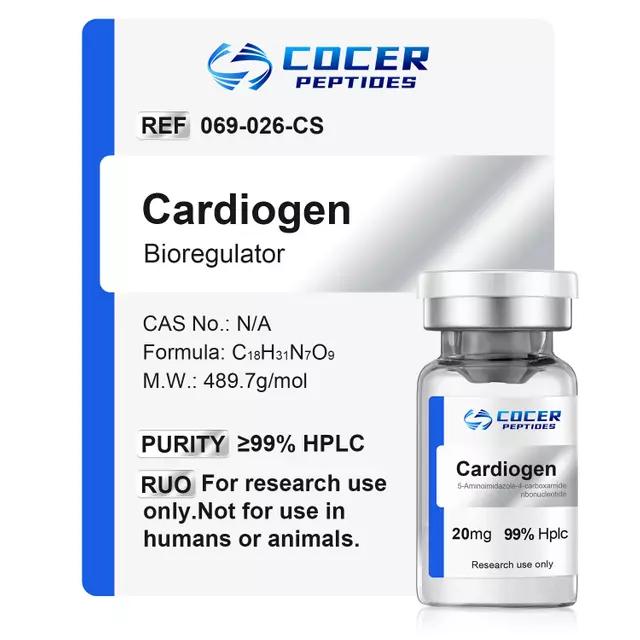
Cardiogen 20mg
Original price was: £55.00.£45.00Current price is: £45.00.
Cardiogen, a short peptide, bioregulates cardiovascular tissues. It protects cells, modulates DNA, and supports heart health by regulating gene expression. It stimulates fibroblast proliferation, promoting collagen and elastin synthesis for tissue repair. Cardiogen may also inhibit cardiomyocyte apoptosis and regulate cell signaling, potentially improving various cardiovascular diseases like heart failure, hypertension, and coronary heart disease.
Description
Cardiogen 20mg – Research Peptide for Cardiovascular Studies
Cardiogen 20mg is a synthetic tetrapeptide with the amino acid sequence Ala-Glu-Asp-Arg (AEDR), specifically designed for advanced cardiovascular research applications. This research peptide serves as a valuable molecular tool for investigating peptide-mediated pathways, cellular signaling mechanisms, and myocardial tissue responses in controlled laboratory settings. With a molecular weight of approximately 489.5 Da and a purity of ≥98% verified by HPLC analysis, Cardiogen represents a high-quality research compound for scientists exploring the fundamental mechanisms underlying cardiac function and dysfunction.
⚠️ Important Notice: Cardiogen 20mg is a research-purpose product strictly intended for laboratory use only. This product is not for human or veterinary consumption and is not approved for clinical or therapeutic applications by the MHRA or any other regulatory authority. All orders are subject to verification of research status.
Understanding Cardiogen: Structure and Biochemical Profile
Cardiogen is a short-chain peptide composed of four carefully selected amino acids: alanine, glutamic acid, aspartic acid, and arginine. This specific sequence, often abbreviated as AEDR, was designed to target cellular processes within the cardiovascular system. The peptide’s small molecular size and polar composition may facilitate cellular uptake and intracellular localization, making it particularly valuable for studies investigating peptide-cell interactions.
The peptide is manufactured via solid-phase peptide synthesis (SPPS), a well-established method that ensures consistent quality and high purity. Each batch of Cardiogen 20mg undergoes rigorous quality control testing, including HPLC analysis to confirm purity levels of ≥98%. This level of quality assurance is essential for researchers who require reproducible results in their experimental work.
As a research compound, Cardiogen serves as a valuable tool for probing peptide-mediated pathways, enabling detailed exploration of molecular interactions relevant to cardiac function and cellular communication. Its defined sequence and stability make it suitable for various experimental systems where precise modulation of peptide activity is required. The broader field of peptide research, including studies on compounds like NMEG-CGRP, has demonstrated that specific modifications can significantly enhance stability and bioavailability, opening new avenues for cardiovascular research.
For researchers seeking comprehensive information on peptide synthesis and characterization, the National Institute for Biological Standards and Control (NIBSC) provides essential reference materials and standards for biological medicines, including peptides used in research applications.
Product Specifications
| Parameter | Details |
|---|---|
| Product Name | Cardiogen 20mg |
| Sequence | H-Ala-Glu-Asp-Arg-OH (AEDR) |
| Molecular Formula | C₁₈H₃₁N₇O₉ |
| Molecular Weight | 489.5 Da |
| Purity | ≥98% (HPLC) |
| Form | Lyophilized powder |
| Storage | Store at ≤ -20°C |
| Source | Synthetic (Solid-Phase Peptide Synthesis) |
| Solubility | Soluble in aqueous solutions |
Scientific Background: The Role of Peptides in Cardiovascular Research
Peptides have emerged as crucial tools in biomedical research, offering unique advantages over larger proteins and small molecules. Their relatively small size allows for better tissue penetration, while their specificity enables targeted modulation of biological pathways. In cardiovascular research, peptides have been instrumental in understanding the complex signalling networks that regulate heart function, blood pressure, and vascular health.
The Significance of Tetrapeptides
Tetrapeptides, consisting of four amino acids, represent a particularly interesting class of research compounds. Their short length makes them synthetically accessible while maintaining sufficient complexity to exhibit biological activity. The AEDR sequence found in Cardiogen has been the subject of research interest due to its potential effects on myocardial tissue.
According to the European Society of Cardiology (ESC) , cardiovascular disease remains the leading cause of death worldwide, driving continued interest in novel research approaches. Peptide-based research tools like Cardiogen contribute to this effort by enabling scientists to explore fundamental mechanisms at the molecular level.
Tissue-Specific Peptide Action
One of the most intriguing aspects of peptides like Cardiogen is their potential for tissue-specific action. Unlike many small molecules that affect multiple organ systems, peptides can be designed to interact preferentially with specific tissues. This selectivity is achieved through the precise arrangement of amino acids, which determines binding affinity for particular receptors or cellular targets.
Research suggests that Cardiogen may interact with myocardial cells in a targeted manner, potentially influencing metabolic processes and cellular signalling pathways. This tissue specificity makes it particularly valuable for cardiovascular research applications where researchers need to isolate effects on cardiac tissue from broader systemic influences.
Research Applications of Cardiogen 20mg
1. Myocardial Tissue Studies
Cardiogen’s defined sequence and tissue-specific properties make it particularly valuable for investigating myocardial cellular processes. Research has demonstrated that the peptide may influence metabolic processes in myocardial cells, potentially improving contractile function parameters in experimental models. These properties make it an important tool for researchers investigating the fundamental mechanisms underlying cardiovascular function and dysfunction.
Studies in organotypic tissue culture have demonstrated that Cardiogen exhibits a significant stimulating effect on cell proliferation in myocardial tissue from both young and aged animal models. Immunohistochemical analysis indicated that Cardiogen may decrease p53 protein expression, suggesting a potential role in inhibiting apoptosis (programmed cell death) in myocardial tissue. This research direction is particularly relevant for understanding age-related changes in cardiac function.
For researchers exploring peptide-based therapeutic strategies, the Polymers & Peptides Research Group at The University of Manchester provides extensive academic research on peptide materials and their biomedical applications, offering valuable context for understanding peptide behaviour in biological systems.
2. Receptor Binding and Structure-Activity Relationship (SAR) Studies
The defined sequence of Cardiogen makes it an ideal template for systematic SAR investigations. Researchers can employ the peptide to explore how specific amino acid substitutions or structural modifications influence biological activity and receptor interaction. Such studies are instrumental in identifying critical sequence motifs responsible for bioactivity, guiding the rational design of next-generation peptide analogues.
Key research approaches include:
-
Alanine Scanning: Systematically replacing each amino acid with alanine to identify residues critical for activity
-
D-Amino Acid Substitution: Replacing L-amino acids with their D-counterparts to investigate stereospecific requirements
-
Truncation Studies: Removing amino acids to determine the minimum sequence required for activity
-
Homology Modelling: Comparing Cardiogen with other bioactive peptides to identify conserved structural features
3. Cellular Mechanism Research
Investigations suggest that Cardiogen may influence multiple cellular processes:
Fibroblast Activity and Matrix Support: Cardiogen may stimulate fibroblast-driven synthesis of extracellular matrix components, including collagen and elastin, supporting structural integrity in myocardial repair contexts. This is particularly relevant for research into cardiac remodelling and tissue repair mechanisms.
Cardiomyocyte Survival Signalling: The peptide may downregulate pro-apoptotic mediators such as p53, mitigating programmed cell death in stressed cardiomyocytes. This property makes it valuable for studying cell survival pathways in the context of ischaemic injury.
Proliferation Support: Cardiogen may promote the proliferation of progenitor-like cells within cardiac tissues, supporting regenerative signalling pathways. This application is of interest to researchers investigating endogenous cardiac repair mechanisms.
Mitochondrial and Redox Modulation: Investigations suggest Cardiogen may interact with cellular antioxidant pathways and support mitochondrial function, helping cells withstand stressors such as ischaemia or metabolic challenges in model systems.
The British Heart Foundation (BHF) supports extensive research into cardiovascular disease mechanisms and provides valuable resources for researchers in this field, including information on emerging research tools and methodologies.
4. Gene-Protein Pathway Analysis
Cardiogen can be deployed in transcriptomic or proteomic assays to map downstream signalling cascades, including MAPK pathways, Akt activation, or p53 suppression. Studies have indicated that Cardiogen may modulate DNA hydrolysis and repair processes, potentially through interaction with endonucleases.
Common experimental approaches include:
-
RNA Sequencing: Analysing global gene expression changes in Cardiogen-treated cells
-
Western Blotting: Quantifying specific protein expression and phosphorylation changes
-
Immunohistochemistry: Localising peptide effects within tissue sections
-
qPCR: Quantifying gene expression for specific targets of interest
5. Peptide Synthesis Optimisation
Cardiogen is frequently used as a reference or test substrate in the optimisation of solid-phase peptide synthesis (SPPS) protocols. Its moderate length and sequence complexity provide a practical model for evaluating coupling efficiencies and protecting group strategies. This application is particularly relevant for laboratories developing new synthetic methodologies or establishing quality control procedures.
For the latest developments in peptide drug discovery and manufacturing, Imperial College London’s spinout Orthogonal Peptides represents cutting-edge research in peptide therapeutics, demonstrating the growing commercial and academic interest in peptide-based research tools.
6. Ischaemia-Reperfusion and Hypoxia Studies
In models of hypoxic challenge or ischaemia-reperfusion, Cardiogen’s antioxidant and anti-apoptotic properties may help researchers define cellular thresholds for irreversible injury and investigate mitochondrial stress response pathways. These studies are particularly relevant for understanding the mechanisms of myocardial infarction and potential strategies for limiting ischaemic damage.
Technical Considerations for Researchers
Peptide Stability
As a small tetrapeptide, Cardiogen may be susceptible to rapid proteolytic degradation in certain experimental conditions. Researchers should consider stabilization strategies, such as modified amino acids or delivery vehicles, to maintain active concentrations in assays. Proper storage at or below -20°C is essential for maintaining product integrity.
Stability Considerations:
| Factor | Impact | Mitigation |
|---|---|---|
| Temperature | Degradation increases with temperature | Store at ≤ -20°C |
| pH | Peptide stability varies with pH | Use buffered solutions at optimal pH |
| Proteases | Enzymatic degradation | Add protease inhibitors |
| Freeze-Thaw | Repeated cycles reduce integrity | Aliquoting single-use portions |
| Light Exposure | Possible photodegradation | Store in amber vials |
Concentration-Response Characterisation
Empirical mapping of concentration ranges is essential for delineating functional windows in Cardiogen research. Different concentrations may drive fibroblast proliferation versus cardiomyocyte survival, requiring careful experimental design. Researchers should establish concentration-response curves for their specific experimental systems to identify optimal working concentrations.
Mechanistic Specificity
Because Cardiogen appears to affect multiple pathways, research models must be designed to isolate specific downstream effects via targeted assays. Using complementary approaches such as gene expression analysis, protein profiling, and functional assays can help distinguish primary from secondary effects.
Data Interpretation
When interpreting experimental results with Cardiogen, researchers should consider:
-
Cell Type Specificity: Effects may vary between different cell types
-
Species Differences: Responses may differ between species
-
Context Dependency: Effects may be modified by experimental conditions
-
Concentration Dependence: Different concentrations may produce different effects
Product Handling and Storage Guidelines
| Storage Condition | Temperature | Duration |
|---|---|---|
| Lyophilized Powder | ≤ -20°C | Extended stability |
| Reconstituted Solution | -80°C | Short-term only |
| Away from Light | Amber vials | Protection from photodegradation |
| Avoid Freeze-Thaw | Aliquot portions | Maintaining integrity |
Reconstitution Protocol:
-
Allow vial to reach room temperature before opening
-
Reconstitute in sterile buffer (PBS, saline, or cell culture medium)
-
Avoid vortexing—gently swirl to dissolve
-
Aliquot into single-use portions
-
Store at -80°C for long-term storage
Quality Assurance
Cardiogen 20mg is manufactured to the highest research-grade standards:
-
High Purity: ≥98% purity confirmed by HPLC analysis
-
Synthetic Origin: Produced via solid-phase peptide synthesis
-
cGMP Compliance: Manufactured in accordance with current Good Manufacturing Practice standards where applicable
-
Batch Traceability: Each batch is assigned a unique identifier for complete traceability
For researchers requiring peptide characterisation data, NovoPro Bioscience offers detailed product specifications for Cardiogen/AEDR peptide, including analytical data and purity certifications.
Future Research Directions
Peptide Analogue Development
Designing modified Cardiogen analogues featuring resistant amino acids or opposing chirality may help dissect structure-function relationships and refine target specificity. This approach has proven valuable in peptide research, with modifications often revealing novel biological activities.
Combined Modality Approaches
Exploring Cardiogen in conjunction with other peptide bioregulators may yield synergistic modulation of repair and regeneration pathways in research models. The British Pharmacological Society provides resources for researchers investigating combined therapeutic approaches, including peptide combinations.
Organoid and 3D Tissue Platforms
The application of Cardiogen within cardiac organoid systems may help researchers study multicellular architecture and mechanical function under stress conditions. This emerging field represents a significant advance in cardiovascular research, enabling more physiologically relevant experimental systems.
In Silico Modelling
Computational approaches, including molecular docking and molecular dynamics simulations, may help predict Cardiogen’s interactions with potential targets and guide experimental design. These approaches are increasingly valuable in peptide research, providing hypotheses for experimental validation.
For researchers investigating peptide applications in tissue engineering, a recent study on laminin-derived peptides demonstrates the potential of bioactive peptides in guiding cardiomyogenesis and cardiac tissue regeneration, highlighting the broader context of peptide research in cardiovascular applications.
Frequently Asked Questions
What is Cardiogen?
Cardiogen is a synthetic tetrapeptide with the amino acid sequence Ala-Glu-Asp-Arg (AEDR), used in cardiovascular research applications. It is a research-purpose product and is not for human or veterinary use.
What is the molecular weight of Cardiogen?
Cardiogen has a molecular weight of approximately 489.5 Da.
How should Cardiogen be stored?
Lyophilised Cardiogen powder should be stored in a freezer at or below -20°C to maintain product integrity. Once reconstituted, aliquots should be stored at -80°C.
Is Cardiogen approved for human use?
No. Cardiogen is strictly a research-purpose product intended for laboratory use only. It is not approved for clinical or therapeutic applications by the MHRA or any other regulatory authority.
What research applications is Cardiogen suitable for?
Cardiogen is suitable for receptor binding assays, structure-activity relationship studies, cellular mechanism research, myocardial tissue studies, ischaemia-reperfusion studies, and peptide synthesis optimisation.
What purity is Cardiogen available in?
Cardiogen 20mg is available with a purity of ≥98% as verified by HPLC analysis.
Can Cardiogen be used in human or animal studies?
No. Cardiogen is strictly a research-purpose product intended for in vitro laboratory use only. It is not approved for use in humans or animals.
How is Cardiogen supplied?
Cardiogen is supplied as a lyophilised powder in a sealed vial, containing 20mg of the peptide.
Conclusion
Cardiogen 20mg (AEDR peptide) is a research-grade tetrapeptide with demonstrated utility in cardiovascular research applications. Its defined sequence, high purity, and documented biological properties make it a valuable tool for investigating myocardial cellular mechanisms, peptide signalling pathways, and tissue repair processes in controlled laboratory settings.
As cardiovascular disease continues to represent a significant global health burden, research tools like Cardiogen contribute to the scientific community’s efforts to understand fundamental disease mechanisms and develop novel therapeutic approaches. The compound’s properties, including its potential effects on myocardial proliferation, apoptosis, and extracellular matrix dynamics, position it as a valuable addition to the cardiovascular researcher’s toolkit.
As with all research compounds, Cardiogen is intended for laboratory use only and requires careful handling, proper storage conditions, and rigorous experimental design to yield meaningful data. Researchers should consult relevant literature and consider the technical considerations outlined above to optimise their experimental approaches with Cardiogen.
For researchers committed to advancing cardiovascular science, the American Heart Association (AHA) provides comprehensive resources, research funding opportunities, and scientific publications that support the broader research community.
Related products
-
-
Sale!
-
Sale!
Abaloparatide 3mg (1kit 10 vials)
Original price was: £55.00.£45.00Current price is: £45.00. -
Sale!
Reviews
There are no reviews yet.