
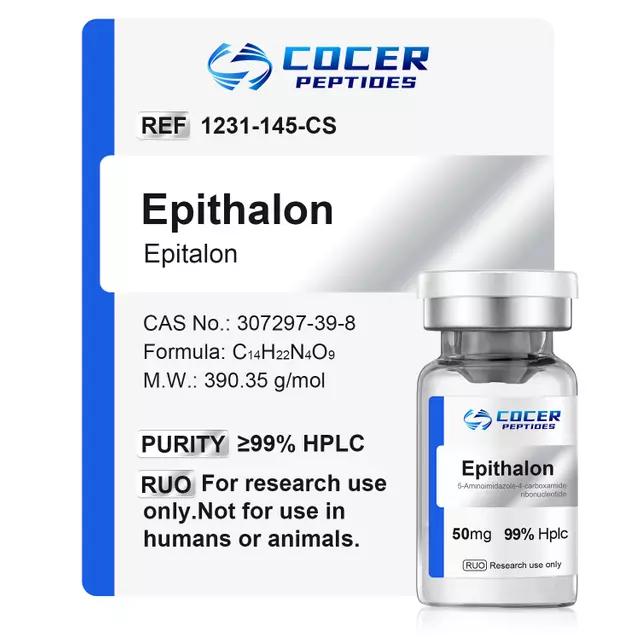
Epithalon 20mg
Description
Epithalon – Research-Grade Pineal Tetrapeptide for Longevity Studies
Cocer Peptides is proud to offer Epithalon, a high-purity research-grade tetrapeptide bioregulator with the amino acid sequence Ala-Glu-Asp-Gly (AEDG) .
With a molecular formula of C₁₄H₂₂N₄O₉ and a molecular weight of 390.35 g/mol, this synthetic peptide represents a significant tool for researchers investigating telomerase activation, pineal gland function, and age-related biological mechanisms .
Epithalon was developed in the 1980s by a research team led by Professor Vladimir Khavinson of the St. Petersburg Institute of Bioregulation and Gerontology, based on the amino acid composition of Epithalamin—a bovine pineal gland polypeptide extract .
⚠️ Important Notice: This product is supplied for laboratory research use only. It is not intended for human or veterinary consumption and must not be used in clinical or therapeutic applications.
As a research peptide, Epithalon provides scientists with a reliable tool for investigating telomerase activity, melatonin synthesis regulation, and the molecular mechanisms underlying cellular aging .
The compound is of particular interest to researchers studying geroprotection, neuroendocrine regulation, and the epigenetic modulation of age-associated changes .
The National Institutes of Health maintains extensive databases on peptide research, and investigations into Epithalon continue to expand our understanding of aging biology.
Research published in peer-reviewed journals and documented in the PubMed database has explored the biochemical properties and potential research applications of this peptide.
The Google Scholar database provides access to thousands of citations on peptide bioregulation and gerontology research.
Meanwhile, ScienceDirect and ResearchGate offer additional resources for researchers exploring anti-aging peptides.
What Is Epithalon?
Epithalon is a synthetic tetrapeptide bioregulator consisting of four amino acids: alanine, glutamic acid, aspartic acid, and glycine (AEDG) .
It was developed following the discovery of bioactivity in Epithalamin, a pineal polypeptide extract from cattle, which had been shown to possess unique properties in in vitro and in vivo experiments .
The peptide mimics the function of naturally occurring pineal peptides involved in neuroendocrine regulation and aging processes .
Structure and Composition:
| Property | Specification |
|---|---|
| Product Name | Epithalon |
| Molecular Formula | C₁₄H₂₂N₄O₉ |
| Molecular Weight | 390.35 g/mol |
| Sequence | Ala-Glu-Asp-Gly (AEDG) |
| Purity | ≥98% (HPLC verified) |
| Research Area | Gerontology, Pineal Biology |
Research has demonstrated that Epithalon exhibits significant geroprotective and neuroendocrine effects, resulting from its antioxidant, neuro-protective, and antimutagenic properties .
The peptide is manufactured as a lyophilised solid, a drying process that preserves structural integrity and ensures stability during storage.
This form allows researchers to reconstitute the compound at desired concentrations for specific assay requirements.
Chemical and Structural Properties
Molecular Characteristics
| Property | Specification |
|---|---|
| Product Name | Epithalon |
| Molecular Formula | C₁₄H₂₂N₄O₉ |
| Molecular Weight | 390.35 g/mol |
| Sequence | Ala-Glu-Asp-Gly (AEDG) |
| Purity | ≥98% (HPLC verified) |
| Form | Lyophilised Solid |
| Research Area | Gerontology, Pineal Biology |
The tetrapeptide sequence Ala-Glu-Asp-Gly (AEDG) provides Epithalon with its specific biological activity .
Research has shown that Epithalon and other pineal peptides act through both specific and nonspecific mechanisms to influence cellular function .
Epithalon’s molecular weight of 390.35 g/mol positions it within the class of small peptides capable of efficient cellular interaction and nuclear penetration .
These structural properties—accessible via the NIH chemical database—enable Epithalon to function as a bio-regulatory peptide that can enter the nucleus and influence gene expression .
Purity and Quality Standards
Epithalon is manufactured to meet research-grade specifications with a guaranteed purity of ≥98% verified by High-Performance Liquid Chromatography (HPLC).
This level of purity is essential for research applications where contaminant interference could compromise experimental validity.
Independent batch testing is conducted to verify:
-
Peptide identity and sequence confirmation
-
Purity verification via HPLC
-
Residual solvent analysis
-
Endotoxin testing (where applicable)
Researchers can access the Certificate of Analysis (COA) for each batch, providing full transparency on product quality and testing parameters.
Research Applications of Epithalon
Telomerase Activation and Telomere Elongation
The primary research interest in Epithalon centres on telomerase activation and telomere elongation studies .
Research by Khavinson and colleagues in 2003 demonstrated that Epithalon elongates telomeres and induces telomerase activity when introduced to telomerase-negative human fetal fibroblast cultures .
The researchers concluded that Epithalon may prolong the lifespan of cell populations through anti-senescence activity .
Recent studies have confirmed that Epithalon extends telomere length in normal healthy mammalian cells through the upregulation of hTERT mRNA expression and telomerase enzyme activity .
In cancer cells, significant telomere length extension has been observed through ALT (Alternative Lengthening of Telomeres) activation, with only a minor increase in ALT activity in normal cells .
Research published in Biogerontology and indexed on PubMed has provided quantitative data on the biomolecular pathway leading to telomere length increase .
Melatonin Synthesis and Pineal Function
Epithalon has been studied for its direct influence on melatonin synthesis in pineal cells .
Research on pinealocyte cultured cells has demonstrated that Epithalon significantly impacts the expression of the pCREB transcription factor and AANAT enzyme, suggesting a direct effect on melatonin synthesis .
Epithalon showed a more prolonged mechanism of action than other peptides and was significantly more potent after three hours of the experiment .
The peptide has been investigated as a regulator of the sleep cycle, as it increases levels of melatonin and endogenous gonadotropic hormones, which play a role in reproductive function but naturally decline with age .
Neuroprotection and Gene Expression
Epithalon has demonstrated neuroprotective effects in various research models.
Studies have shown that Epithalon increases the transcriptional levels of Nestin and GAP43, genes associated with neurogenesis .
In human gingival mesenchymal stem cells, treatment with Epithalon significantly upregulated the expression of neurogenesis-related genes and the synthesis of β-tubulin III and Doublecortin .
Research published in Neurochemical Journal and indexed on PubMed demonstrated that Epithalon prevents the decrease in neprilysin and insulin-degrading enzyme expression induced by hypoxia in NB7 neuroblastoma cells .
Antiapoptotic Research
Epithalon has been investigated for its antiapoptotic properties.
Research published in Bulletin of Experimental Biology and Medicine and indexed on PubMed examined the effects of Epithalon on irradiation-induced apoptotic death of spleen lymphocytes in rats .
The study indicated that this peptide inhibits physiologically programmed cell death, suggesting potential applications in cellular protection research .
Anti-Tumor Research
Epithalon has been investigated in the context of cancer research.
Research published in Bulletin of Experimental Biology and Medicine demonstrated that Epithalon suppressed tumor growth and extended the lifetime in transgenic HER-2/neu mice .
The peptide has been shown to inhibit carcinogenic receptor expression, which has led to research into its potential anti-tumor effects in breast and colorectal cancer .
Retinal Protection Research
Epithalon has demonstrated retinal protective effects in research models.
Research published in Bulletin of Experimental Biology and Medicine and indexed on PubMed examined the effect of Epithalon on hereditary pigmentary retinal degeneration in Campbell rats .
Administration of Epithalon protected morphological structure, increased its bioelectrical activity, and improved its function .
Anti-Inflammatory Research
Epithalon has been studied for its anti-inflammatory properties.
Research has shown that Epithalon can regulate biomolecules involved in the inflammation process, such as cytokines and C-reactive protein .
The peptide has been investigated as a potential research tool for studying rheumatoid arthritis and ulcerative colitis due to its ability to regulate inflammatory pathways .
Antioxidant Research
Epithalon has demonstrated significant antioxidant effects in research models.
Studies have shown that Epithalon alleviates UV-induced oxidative stress and increases the expression of SOD-1, NQO1, and CATALASE genes in dermal fibroblasts .
These antioxidant properties contribute to the peptide’s geroprotective effects and make it a valuable research tool for studying oxidative stress mechanisms.
Technical Specifications
| Specification | Detail |
|---|---|
| Product Name | Epithalon |
| Molecular Weight | 390.35 g/mol |
| Molecular Formula | C₁₄H₂₂N₄O₉ |
| Sequence | Ala-Glu-Asp-Gly (AEDG) |
| Purity | ≥98% (HPLC) |
| Form | Lyophilised Solid |
| Research Areas | Gerontology, Pineal Biology |
| Storage | 2–8°C |
Reconstitution and Handling Protocol
Recommended Storage Conditions
Epithalon is supplied as a lyophilised solid and should be stored at 2–8°C to maintain stability and potency.
Proper temperature control prevents degradation and preserves the peptide’s structural integrity.
-
Short-term storage: 2–8°C (refrigeration)
-
Long-term storage: -20°C or below (freezer)
-
Protect from light: Store in original packaging or dark conditions
-
Do not freeze: After reconstitution, avoid repeated freeze-thaw cycles
Reconstitution Guidelines
For best results in a research setting, allow both the peptide and chosen solvent to reach ambient laboratory temperature before reconstitution.
This helps maintain structural integrity during dissolution.
Standard reconstitution protocol:
-
Bring lyophilised peptide and solvent to room temperature
-
Add the appropriate volume of sterile solvent (water for injection, PBS, or bacteriostatic water)
-
Gently swirl—do not vortex or shake vigorously
-
Allow to fully dissolve before use
-
Use within the recommended timeframe
Dissolved solutions should be aliquoted and stored at -20°C to avoid repeated freeze-thaw cycles, and are best used fresh after preparation.
Quality Assurance and Testing
Cocer Peptides is committed to providing research-grade compounds that meet the highest standards of quality and consistency.
Each batch undergoes rigorous testing to verify:
-
Identity confirmation: Mass spectrometry verification
-
Purity analysis: HPLC with ≥98% purity threshold
-
Content uniformity: Consistency across vials
-
Residual solvent analysis: Within acceptable limits
Independent third-party testing is conducted to ensure unbiased verification.
Researchers can view the Certificate of Analysis for their specific batch directly on our site, providing full transparency and traceability.
Frequently Asked Questions (FAQ)
What is Epithalon?
This compound is a synthetic tetrapeptide bioregulator composed of alanine, glutamic acid, aspartic acid, and glycine (AEDG) .
It is a research peptide designed to modulate pineal gland function and telomerase activity through cellular signalling mechanisms .
Comprehensive research on anti-aging peptides is available through PubMed and Google Scholar.
What is the purity of Epithalon?
This compound is guaranteed to have a purity of ≥98% verified by HPLC testing.
Each batch is independently tested to ensure quality and consistency.
How should Epithalon be stored?
This compound should be stored at 2–8°C as a lyophilised solid.
After reconstitution, it should be refrigerated and used within the recommended timeframe to maintain stability.
What research applications is Epithalon used for?
This compound is used in research exploring telomerase activation, telomere elongation, melatonin synthesis, neuroprotection, anti-tumor mechanisms, retinal protection, anti-inflammatory pathways, and antioxidant mechanisms .
For a comprehensive overview of peptide research applications, researchers are encouraged to explore the PubMed database.
ScienceDirect and ResearchGate offer additional resources for researchers exploring anti-aging peptides.
How should I reconstitute Epithalon?
Allow both the peptide and solvent to reach room temperature before reconstitution.
Add the appropriate volume of sterile solvent and gently swirl to dissolve.
Do not vortex or shake vigorously.
Is Epithalon approved for human use?
No. This compound is strictly for laboratory research use only and is not approved for human or veterinary use as a research product.
This product must not be used in clinical or therapeutic applications.
Conclusion
Epithalon (Ala-Glu-Asp-Gly) represents a powerful research tool for scientists investigating telomerase activation, pineal gland function, and the molecular mechanisms underlying cellular aging .
With a molecular weight of 390.35 g/mol and guaranteed purity of ≥98%, this tetrapeptide bioregulator offers the consistency and reliability required for reproducible research outcomes.
The peptide’s demonstrated effects in telomere elongation, melatonin synthesis regulation, neuroprotection, and antioxidant mechanisms make it a versatile tool for gerontological research .
Research published in peer-reviewed journals and documented in the PubMed database has explored the biochemical properties and potential research applications of this peptide.
The Google Scholar database provides access to thousands of citations on peptide bioregulation and gerontology research.
Meanwhile, ScienceDirect and ResearchGate offer additional resources for researchers exploring anti-aging peptides.
As with all research peptides, this compound is intended for laboratory use only and should be handled according to established protocols for peptide-based research.
Cocer Peptides is proud to provide UK researchers with access to high-quality, independently tested research compounds.
Related Research Products
-
Bioregulator Peptides – View our complete bioregulator collection
-
Certificate of Analysis – Access batch-specific COA data
-
Research Peptides – Explore our full peptide catalogue
-
Reconstitution Guide – Comprehensive handling protocols
-
Contact Us – For research support and enquiries
Disclaimer: This product is supplied for laboratory research use only. It is not intended for human or veterinary use and must not be used in any medical, therapeutic, or clinical applications. The information provided is for educational and research purposes only. Always follow standard laboratory safety protocols when handling research compounds.
Reviews
There are no reviews yet.