
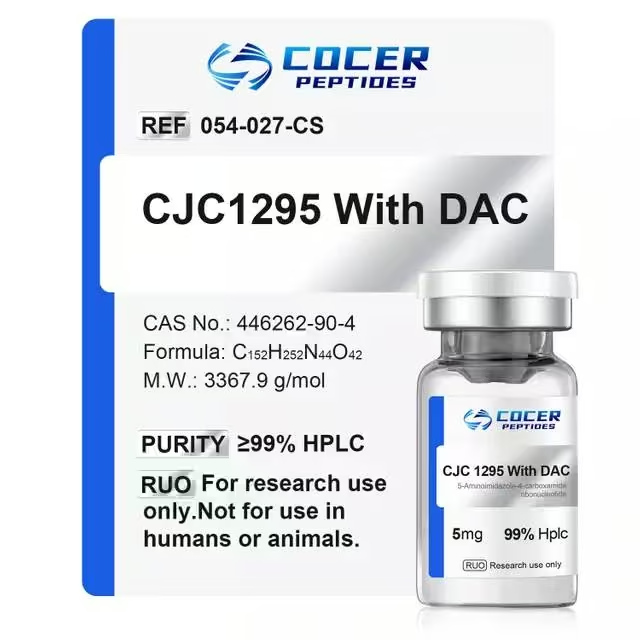
CJC 1295 No DAC 5mg
Original price was: £95.00.£85.00Current price is: £85.00.
🧬 CJC 1295 – Research Grade
-
🔬 High-purity GHRH analogue (No DAC)
-
✅ ≥99% purity, HPLC tested
-
📦 Premium research peptide for lab use
-
💧 Free bacteriostatic water with every order
-
🧪 For research use only
Order now – CJC 1295 for UK labs! 🚀
15% DISCOUNT ON CHECKOUT WITH CRYPTO
- Satisfaction Guaranteed
- No Hassle Refunds
- Secure Payments
Description
CJC 1295 – Premium Research Grade GHRH Analogue
Product Overview
CJC 1295 is a synthetic analogue of growth hormone-releasing hormone (GHRH) designed for laboratory investigation of the GH/IGF-1 axis. The compound is a 29-amino acid peptide with a C-terminal amide function, identified through mass spectrometry analysis of research preparations . Unlike the DAC-conjugated version, the No DAC form (also known as Modified GRF 1-29) lacks the drug affinity complex moiety, resulting in a significantly shorter half-life of approximately 30 minutes .
Researchers investigating this GHRH analogue frequently study its capacity to stimulate endogenous growth hormone release. According to a randomised controlled trial published in the Journal of Clinical Endocrinology and Metabolism, administration produced dose-dependent increases in mean plasma GH concentrations by 2- to 10-fold for 6 days or more and in mean plasma IGF-I concentrations by 1.5- to 3-fold for 9-11 days . The estimated half-life of the DAC-conjugated form was 5.8-8.1 days, with IGF-I levels remaining above baseline for up to 28 days after multiple doses .
This research product is supplied as a lyophilized powder for laboratory investigation of GHRH receptor pharmacology and pulsatile GH secretion. Each batch undergoes rigorous quality control to ensure purity and consistency.
Regulatory Notice: This peptide holds no UK marketing authorisation. UK medical professionals have been warned that none of these peptides currently hold MHRA approval for human therapeutic use, and the “research only” label does not provide legal immunity if human use is implied . It is also a prohibited substance under the World Anti-Doping Agency (WADA) Prohibited List . This product is supplied strictly for research purposes only and is not intended for human or veterinary use.
Product Specifications
| Feature | Specification |
|---|---|
| Peptide Name | CJC 1295 No DAC (Mod GRF 1-29) |
| Alternative Names | Modified GRF (1-29), CJC-1295-no DAC, GHRH (1-29)-NH2 |
| Amino Acid Count | 29 |
| Molecular Formula | C₁₅₂H₂₅₂N₄₄O₄₂ |
| Molecular Weight | 3367.9 Da |
| Purity | ≥99% (HPLC) |
| Form | Lyophilized powder |
| Storage | -20°C (long-term), 2–8°C (short-term) |
| For Research Use Only | Not for human or veterinary use |
Mechanism of Action
GHRH Receptor Agonism
This compound binds to GHRH receptors on pituitary somatotroph cells, stimulating endogenous growth hormone secretion . This mechanism distinguishes it from exogenous GH administration, as it works with the body’s own feedback loops rather than suppressing natural production. The compound increases secretion of growth hormone in primary rat anterior pituitary cells when used from picomolar to micromolar concentrations .
No DAC – Pulsatile Research Model
The absence of the Drug Affinity Complex in the No DAC form produces a pharmacokinetic profile distinct from the DAC-conjugated version. With a half-life of approximately 30 minutes, the No DAC form more closely mimics natural GH pulses but requires more frequent administration in research models . As documented by Bertin Bioreagent, the without-DAC version has a shorter half-life than the DAC-conjugated version in the blood.
Downstream IGF-1 Effects
Stimulation of GH release produces downstream elevations in IGF-1, a primary mediator of growth hormone’s anabolic effects. The clinical trial data showed IGF-1 increases of 1.5- to 3-fold sustained for 9-11 days after a single injection . Researchers investigating this compound for metabolic studies frequently monitor both GH and IGF-1 as co-primary endpoints.
Research Applications
Growth Hormone Axis Studies
This GHRH analogue is a foundational tool for investigating GHRH receptor pharmacology and pulsatile GH secretion. The compound has been characterised in peer-reviewed human studies, with a Phase 1 trial in healthy adults demonstrating dose-dependent increases in GH and IGF-1 . Researchers can study the No DAC form to examine short-duration GH pulses, or compare it against the DAC-conjugated version to investigate half-life effects.
Body Composition and Metabolic Research
The GH/IGF-1 axis plays a central role in body composition regulation. According to a Frontiers in Endocrinology review, GHRH analogues like this compound are studied for potential metabolic and anabolic effects through sustained GH/IGF-1 elevation, including favourable shifts in body composition . Preclinical models have examined effects on lipolysis and lean mass preservation.
Regulatory and Analytical Research
This peptide has been identified in unknown pharmaceutical preparations seized by police and customs agents, making it a subject of analytical research . The compound is also studied in the context of anti-doping testing, as it is a prohibited substance under WADA regulations . Researchers at Frontiers in Endocrinology have stratified GHRH analogues into evidence tiers, noting that the DAC-conjugated form has Phase I PK/PD studies in healthy adults but no controlled efficacy data .
Quality and Purity
Each batch of Cocer Peptides CJC 1295 undergoes rigorous quality control:
-
≥99% purity verified by HPLC
-
Mass spectrometry identity confirmation
-
Batch/lot number matching the vial label
-
Certificate of Analysis (COA) available on request
The Medicines and Healthcare products Regulatory Agency (MHRA) has warned against purchasing unlicensed medicines and research peptides online, noting that such products may be contaminated, mislabelled, or of unknown potency . Batch-level analytical documentation is therefore essential for research reproducibility.
Frequently Asked Questions
What is CJC 1295?
CJC 1295 is a synthetic analogue of growth hormone-releasing hormone (GHRH) consisting of 29 amino acids with a C-terminal amide function . It is studied for its capacity to stimulate endogenous growth hormone release.
What is the difference between the DAC and No DAC versions?
The DAC-conjugated version has a half-life of 5.8-8.1 days and produces sustained GH elevation . The No DAC form (Mod GRF 1-29) has a half-life of approximately 30 minutes and more closely mimics natural pulsatile GH release .
Is this peptide legal in the UK?
This peptide holds no UK marketing authorisation and is not available via routine NHS prescribing. Under the Human Medicines Regulations 2012, supplying unlicensed peptides for human use is unlawful . This product is supplied for research purposes only.
What purity level can I expect?
Our CJC 1295 is provided at ≥99% purity, verified by HPLC with third-party testing.
How should this peptide be stored?
Store lyophilized powder at -20°C for long-term stability. Reconstituted material should be stored at 2–8°C and used promptly following standard laboratory protocols.
Is this product suitable for human use?
No. This product is supplied strictly for research purposes only and is not intended for human or veterinary use. It is not authorised by the MHRA for human medicinal use and is prohibited by WADA .
Conclusion
This GHRH analogue represents a well-characterised research tool for investigating GHRH receptor pharmacology, pulsatile GH secretion, and downstream IGF-1 effects. With its high-purity formulation and comprehensive quality documentation, this No DAC presentation enables researchers to study short-duration GH pulses in controlled laboratory settings. For UK laboratories sourcing CJC 1295 for research applications, this product offers documented composition, ≥99% purity, and batch-specific COA support.
Ready to Advance Your Research?
Order premium CJC 1295 for your laboratory today.
Reviews
There are no reviews yet.