
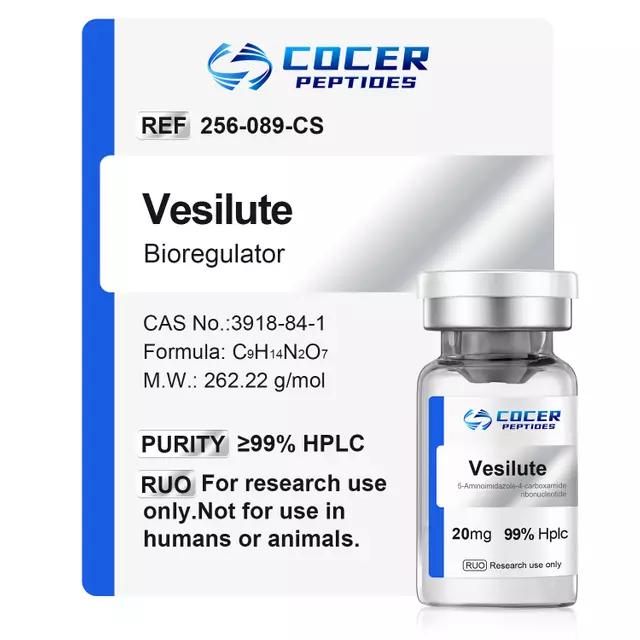
Vesilute 20mg
Vesilute is a bioactive peptide that primarily exerts regulatory effects on urinary system tissues such as the bladder and prostate by influencing gene expression at the cellular level. For instance, in cases of chronic aseptic inflammation of prostate tissue, it helps regulate key indicators including tissue swelling, congestion, and cellular infiltration, thereby improving abnormal conditions in the affected tissues.
The peptide will be provided as lyophilized powder to ensure maximum stability.
Description
Cocer Peptides is proud to offer Vesilute, a high-purity research-grade dipeptide bioregulator with the amino acid sequence Glu-Asp (ED) .
With a molecular formula of C₉H₁₄N₂O₇ and a molecular weight of 262.2 g/mol, this short peptide represents a valuable tool for researchers investigating chromatin dynamics, gene expression modulation, and epigenetic regulation .
Vesilute belongs to the class of Khavinson peptides, developed within the framework of Russian peptide bioregulation research. It shares its Glu-Asp sequence with Prostamax (Lys-Glu-Asp-Pro), suggesting related mechanisms of action at the cellular level .
⚠️ Important Notice: This product is supplied for laboratory research use only. It is not intended for human or veterinary consumption and must not be used in clinical or therapeutic applications.
As a research peptide, Vesilute provides scientists with a reliable tool for investigating chromatin decondensation, gene activation, and the molecular mechanisms underlying cellular ageing and tissue function .
The compound is of particular interest to researchers studying epigenetics, chromosomal dynamics, and the effects of peptide bioregulators on gene expression in ageing cellular models .
The National Institutes of Health maintains extensive databases on peptide research, and investigations into Vesilute continue to expand our understanding of epigenetic regulation.
Research published in peer-reviewed journals and documented in the PubMed database has explored the biochemical properties and potential research applications of related bioregulatory peptides.
The Google Scholar database provides access to thousands of citations on peptide bioregulation and epigenetic research.
Meanwhile, ScienceDirect and ResearchGate offer additional resources for researchers exploring chromatin-modulating peptides.
What Is Vesilute?
Vesilute is a synthetic dipeptide bioregulator consisting of two amino acids: glutamic acid and aspartic acid (Glu-Asp) .
It was developed following the discovery of bioactivity in related peptide bioregulators that interact with chromatin structures within the cellular nucleus .
The peptide mimics the function of naturally occurring regulatory molecules involved in gene expression modulation and chromatin dynamics.
Structure and Composition:
| Property | Specification |
|---|---|
| Product Name | Vesilute |
| Molecular Formula | C₉H₁₄N₂O₇ |
| Molecular Weight | 262.2 g/mol |
| Sequence | Glu-Asp (ED) |
| Purity | ≥98% (HPLC verified) |
| Research Area | Epigenetics, Chromatin Biology |
Research has demonstrated that Vesilute exhibits potential epigenetic regulatory capabilities, with its core efficacy lying in the modulation of chromatin structure and gene accessibility .
The peptide is manufactured as a lyophilised solid, a drying process that preserves structural integrity and ensures stability during storage.
This form allows researchers to reconstitute the compound at desired concentrations for specific assay requirements.
Chemical and Structural Properties
Molecular Characteristics
| Property | Specification |
|---|---|
| Product Name | Vesilute |
| Molecular Formula | C₉H₁₄N₂O₇ |
| Molecular Weight | 262.2 g/mol |
| Sequence | Glu-Asp (ED) |
| Purity | ≥98% (HPLC verified) |
| Form | Lyophilised Solid |
| Research Area | Epigenetics, Chromatin Biology |
The dipeptide sequence Glu-Asp (ED) provides Vesilute with its specific biological activity .
Research has shown that Vesilute and related Khavinson peptides can permeate both cytoplasmic and nuclear membranes due to specific physicochemical properties such as charge, size, and hydrophobicity .
Vesilute’s molecular weight of 262.2 g/mol positions it within the class of small peptides capable of efficient cellular interaction and nuclear penetration .
These structural properties—accessible via the NIH chemical database—enable Vesilute to function as a bio-regulatory peptide that can enter the nucleus and influence chromatin structure .
Purity and Quality Standards
Vesilute is manufactured to meet research-grade specifications with a guaranteed purity of ≥98% verified by High-Performance Liquid Chromatography (HPLC) .
This level of purity is essential for research applications where contaminant interference could compromise experimental validity.
Independent batch testing is conducted to verify:
-
Peptide identity and sequence confirmation
-
Purity verification via HPLC
-
Residual solvent analysis
-
Endotoxin testing (where applicable)
Researchers can access the Certificate of Analysis (COA) for each batch, providing full transparency on product quality and testing parameters.
Research Applications of Vesilute
Chromatin Decondensation and Gene Activation
The primary research interest in Vesilute centres on chromatin decondensation and gene activation studies .
Research has shown that peptides with homology to Vesilute may induce the activation of ribosomal genes by promoting the decondensation of densely packed chromatin fibrils .
This process potentially facilitates the release of genes that may have been previously repressed due to cellular age-associated heterochromatinization .
Studies suggest that Vesilute-like peptides can lead to the decondensation of pericentromeric structural chromatin in chromosome 1, while possibly inducing structural alterations in chromosome 9 as well .
Such changes suggest a potential selective capacity to decrease the size of specific structural heterochromatin blocks .
Research published in Bulletin of Experimental Biology and Medicine and indexed on PubMed has explored the effects of short peptides on lymphocyte chromatin in senile subjects .
Epigenetic DNA Interactions
Vesilute has been studied for its potential epigenetic DNA interactions .
Research conducted by Khavinson et al. suggests that Vesilute may have the ability to interact with specific DNA sequences, particularly ATTT sequences .
The overall strength of the binding may be relatively weak, which is thought by researchers to be a characteristic shared among dipeptides due to their limited area of contact .
Once inside the nuclear environment, Vesilute may interact directly with complementary sequences in gene promoters .
It is theorised that this epigenetic interaction might potentially stimulate the synthesis of relevant mRNA, thereby possibly triggering downstream translation processes .
This posited mechanism might theoretically regulate fundamental cellular activities in in vitro models, such as gene expression and protein synthesis .
Sister Chromatid Exchange Research
Vesilute has been investigated for its effects on sister chromatid exchanges (SCEs) .
Research indicates that peptides similar to Vesilute may increase the frequency of sister chromatid exchanges, particularly affecting chromosome groups A, C, D, and G .
This elevated exchange rate may signify a decondensation of heterochromatinised euchromatin regions, allowing for renewed genetic activity .
SCEs are a natural process where identical sister chromatids exchange genetic material during cell division .
An increase in SCE frequency may suggest a role for Vesilute in enhancing chromosomal repair and maintenance mechanisms, potentially contributing to genomic stability in ageing cells .
Prostate and Bladder Tissue Research
Due to its similarity to Prostamax (Lys-Glu-Asp-Pro), Vesilute is expected to exhibit similar potential action on tissues such as prostate gland cells and bladder cells .
Related bioregulators containing the Glu-Asp sequence have been studied in experimental models of chronic aseptic inflammation in prostate tissues .
Research has suggested that these peptides may influence fluid dynamics and cellular responses in inflamed tissue, leading to a decrease in oedema or swelling .
Studies have also observed potential attenuation of hyperemia, referring to excess blood in the vessels supplying prostate gland tissues .
Crucially, related peptides may block the development of sclerotic processes—the hardening of tissues resulting from prolonged inflammation .
The authors concluded that exposure to related bioregulator peptides led to “reduced swelling intensity, hyperaemia, and cellular infiltration, blocked the development of sclerosal processes” .
Ribosomal RNA Gene Research
Vesilute has been studied for its potential impact on ribosomal RNA (rRNA) gene activity .
Bioregulator peptides similar to Vesilute may increase Ag-positive nucleolus organizer regions (NORs), which are chromosomal regions involved in ribosome formation .
An increase in Ag-positive NORs might indicate enhanced production of rRNA, leading to more ribosomes and thus higher protein synthesis capacity .
This change may be particularly significant in ageing cells, where protein synthesis often decreases .
Cellular Ageing Research
Vesilute has been investigated in the context of cellular ageing research .
Studies suggest that Vesilute may play a role in understanding chromatin dynamics and the regulation of gene activation in ageing cellular models .
The peptide’s potential to support chromatin structures suggests that it might be a valuable tool in research examining genetic regulation and its broader implications for cellular ageing .
Investigations suggest that Vesilute might be utilised in experimental frameworks to explore cellular responses to chromatin remodeling .
Technical Specifications
| Specification | Detail |
|---|---|
| Product Name | Vesilute |
| Molecular Weight | 262.2 g/mol |
| Molecular Formula | C₉H₁₄N₂O₇ |
| Sequence | Glu-Asp (ED) |
| Purity | ≥98% (HPLC) |
| Form | Lyophilised Solid |
| Research Areas | Epigenetics, Chromatin Biology |
| Storage | 2–8°C |
Reconstitution and Handling Protocol
Recommended Storage Conditions
Vesilute is supplied as a lyophilised solid and should be stored at 2–8°C to maintain stability and potency.
Proper temperature control prevents degradation and preserves the peptide’s structural integrity.
-
Short-term storage: 2–8°C (refrigeration)
-
Long-term storage: -20°C or below (freezer)
-
Protect from light: Store in original packaging or dark conditions
-
Do not freeze: After reconstitution, avoid repeated freeze-thaw cycles
Reconstitution Guidelines
For best results in a research setting, allow both the peptide and chosen solvent to reach ambient laboratory temperature before reconstitution.
This helps maintain structural integrity during dissolution.
Standard reconstitution protocol:
-
Bring lyophilised peptide and solvent to room temperature
-
Add the appropriate volume of sterile solvent (water for injection, PBS, or bacteriostatic water)
-
Gently swirl—do not vortex or shake vigorously
-
Allow to fully dissolve before use
-
Use within the recommended timeframe
Dissolved solutions should be aliquoted and stored at -20°C to avoid repeated freeze-thaw cycles, and are best used fresh after preparation.
Quality Assurance and Testing
Cocer Peptides is committed to providing research-grade compounds that meet the highest standards of quality and consistency.
Each batch undergoes rigorous testing to verify:
-
Identity confirmation: Mass spectrometry verification
-
Purity analysis: HPLC with ≥98% purity threshold
-
Content uniformity: Consistency across vials
-
Residual solvent analysis: Within acceptable limits
Independent third-party testing is conducted to ensure unbiased verification.
Researchers can view the Certificate of Analysis for their specific batch directly on our site, providing full transparency and traceability.
Frequently Asked Questions (FAQ)
What is Vesilute?
Vesilute is a synthetic dipeptide bioregulator composed of glutamic acid and aspartic acid (Glu-Asp) .
It is a research peptide designed to modulate chromatin structure and gene expression through epigenetic mechanisms .
Comprehensive research on epigenetic peptides is available through PubMed and Google Scholar .
What is the purity of Vesilute?
Vesilute is guaranteed to have a purity of ≥98% verified by HPLC testing .
Each batch is independently tested to ensure quality and consistency.
How should Vesilute be stored?
Vesilute should be stored at 2–8°C as a lyophilised solid.
After reconstitution, it should be refrigerated and used within the recommended timeframe to maintain stability.
What research applications is Vesilute used for?
Vesilute is used in research exploring chromatin decondensation, epigenetic DNA interactions, sister chromatid exchanges, prostate and bladder tissue function, ribosomal RNA gene activity, and cellular ageing mechanisms .
For a comprehensive overview of peptide research applications, researchers are encouraged to explore the PubMed database.
ScienceDirect and ResearchGate offer additional resources for researchers exploring epigenetic peptides.
How should I reconstitute Vesilute?
Allow both the peptide and solvent to reach room temperature before reconstitution.
Add the appropriate volume of sterile solvent and gently swirl to dissolve.
Do not vortex or shake vigorously.
Is Vesilute approved for human use?
No. Vesilute is strictly for laboratory research use only and is not approved for human or veterinary use as a research product.
This product must not be used in clinical or therapeutic applications.
Conclusion
Vesilute (Glu-Asp) represents a powerful research tool for scientists investigating chromatin dynamics, epigenetic regulation, and the molecular mechanisms underlying gene expression modulation.
With a molecular weight of 262.2 g/mol and guaranteed purity of ≥98%, this dipeptide bioregulator offers the consistency and reliability required for reproducible research outcomes.
The peptide’s demonstrated effects in chromatin decondensation, epigenetic DNA interactions, and cellular ageing mechanisms make it a versatile tool for epigenetic research .
Research published in peer-reviewed journals and documented in the PubMed database has explored the biochemical properties and potential research applications of related bioregulatory peptides.
The Google Scholar database provides access to thousands of citations on peptide bioregulation and epigenetic research.
Meanwhile, ScienceDirect and ResearchGate offer additional resources for researchers exploring chromatin-modulating peptides.
As with all research peptides, Vesilute is intended for laboratory use only and should be handled according to established protocols for peptide-based research.
Cocer Peptides is proud to provide UK researchers with access to high-quality, independently tested research compounds.
Related Research Products
-
Bioregulator Peptides – View our complete bioregulator collection
-
Certificate of Analysis – Access batch-specific COA data
-
Research Peptides – Explore our full peptide catalogue
-
Reconstitution Guide – Comprehensive handling protocols
-
Contact Us – For research support and enquiries
Disclaimer: This product is supplied for laboratory research use only. It is not intended for human or veterinary use and must not be used in any medical, therapeutic, or clinical applications. The information provided is for educational and research purposes only. Always follow standard laboratory safety protocols when handling research compounds.
Reviews
There are no reviews yet.