
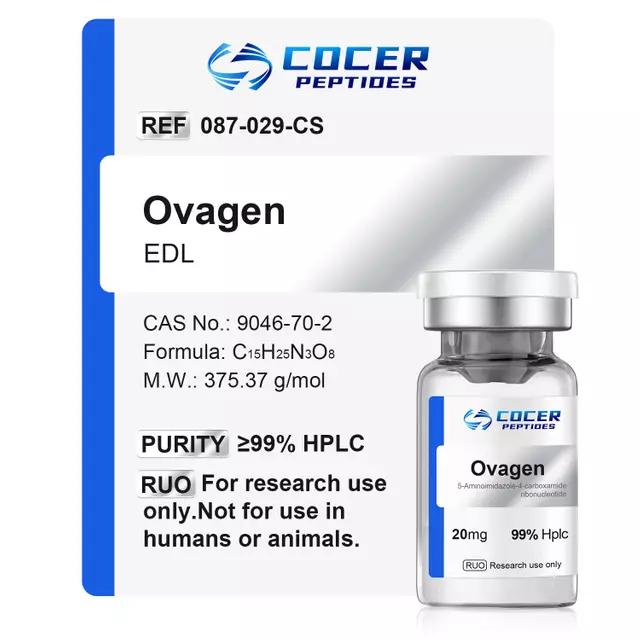
Ovagen 20mg
Original price was: £55.00.£45.00Current price is: £45.00.
Ovagen, a peptide complex with glutamic acid, aspartic acid, and leucine (AC-3 complex), significantly regulates and restores liver and gastrointestinal function. It protects and repairs liver cells, preventing and treating various hepatitis types, mitigating radiotherapy/chemotherapy complications, and alleviating antibiotic/medication side effects. It also combats environmental toxin/malnutrition effects and supports elderly liver function. Ovagen is valuable for studying liver and GI processes.
Description
Ovagen 20mg – High-Purity Research Peptide Bioregulator
Cocer Peptides is proud to offer Ovagen 20mg, a high-purity synthetic peptide bioregulator developed for advanced laboratory research. With a molecular formula of C₁₅H₂₅N₃O₈ and a molecular weight of 375.37 g/mol, this tripeptide—composed of glutamic acid, aspartic acid, and leucine (Glu-Asp-Leu)—is of particular interest in studies exploring liver function, gastrointestinal health, and cellular signalling pathways. The National Institutes of Health (NIH) maintains extensive databases of peptide research, and investigations into bioregulatory peptides like Ovagen continue to expand our understanding of cellular mechanisms .
⚠️ Important Notice: This product is supplied for laboratory research use only. It is not intended for human or veterinary consumption and must not be used in clinical or therapeutic applications.
As a research-grade peptide, Ovagen provides scientists with a reliable tool for investigating bioregulatory mechanisms at the cellular level. According to research by Khavinson et al., published in the peer-reviewed journal Molecules and accessible via PubMed, this class of bioregulators may interact with specific DNA sequences and modify the expression of certain genes, making them valuable tools for epigenetic and gene expression studies . The broader field of peptide bioregulation has been extensively studied, with researchers at leading institutions exploring how these short amino acid sequences influence physiological processes through cellular signalling mechanisms. Recent systematic reviews indexed on Google Scholar and ScienceDirect have documented the growing body of evidence supporting peptide-based research tools .
What Is Ovagen?
Ovagen is a synthetic tripeptide bioregulator consisting of three amino acids: glutamic acid, aspartic acid, and leucine. Bioregulatory peptides are short amino acid sequences that influence physiological processes through cellular signalling mechanisms. The peptide is available at a 20mg concentration in lyophilised solid form, designed for stability and ease of handling in controlled laboratory environments.
The amino acid sequence Glu-Asp-Leu (also referred to as EDL) distinguishes Ovagen from other peptide bioregulators. Each constituent amino acid plays a role in biochemical processes: glutamic and aspartic acids function in neurotransmitter metabolism, while leucine is an essential amino acid critical for metabolic signalling. Researchers can access comprehensive biochemical data on this sequence through ScienceDirect, which hosts extensive literature on amino acid metabolism and peptide function .
Ovagen was developed within the broader framework of peptide bioregulator research, with investigations into its effects on hepatic tissue and gastrointestinal epithelial cells. As documented in research literature available through PubMed and ResearchGate, the peptide demonstrates specific affinity for liver tissue, making it valuable for in vitro applications investigating hepatocyte biology and gastrointestinal tract function . The term “Ovagen” has been referenced in multiple research contexts since 1989, including studies on cellular function and tissue-specific regulation, as catalogued in the PubMed database .
Chemical and Structural Properties
Molecular Characteristics
| Property | Specification |
|---|---|
| Product Name | Ovagen 20mg |
| Catalogue Number | OVAG20-045 |
| Molecular Formula | C₁₅H₂₅N₃O₈ |
| Molecular Weight | 375.37 g/mol |
| Sequence | Glu-Asp-Leu |
| Purity | ≥99% (HPLC verified) |
| Form | Lyophilised Solid |
| Research Area | Liver, GI Tract, Cellular Function |
Ovagen’s molecular structure, with a molecular weight of approximately 375 Da, positions it within the class of small peptides capable of cellular interaction and signalling. Structurally, it has two acidic amino acid residues, carrying a negative charge under physiological pH conditions. This gives it high hydrophilicity and stability, making it primarily act on peripheral tissues like the liver and gastrointestinal epithelial cells. Structural data on similar peptides can be found in the Protein Data Bank and referenced in ScienceDirect publications .
The peptide is manufactured as a lyophilised solid, a drying process that preserves structural integrity and ensures stability during storage. This form allows researchers to reconstitute the peptide at desired concentrations for specific assay requirements.
Purity and Quality Standards
Ovagen 20mg is manufactured to meet research-grade specifications with a guaranteed purity of ≥99% verified by High-Performance Liquid Chromatography (HPLC). This level of purity is essential for research applications where contaminant interference could compromise experimental validity. Methodologies for peptide purity verification are extensively documented in analytical chemistry literature available through Google Scholar .
Independent batch testing is conducted to verify:
-
Peptide identity and sequence confirmation
-
Purity verification via HPLC
-
Residual solvent analysis
-
Endotoxin testing (where applicable)
Researchers can access the Certificate of Analysis (COA) for each batch, providing full transparency on product quality and testing parameters.
Research Applications of Ovagen
Liver Function and Hepatology Research
The primary research interest in Ovagen centres on liver function studies and hepatic cellular models. As a bioregulatory peptide, Ovagen is studied for its potential influence on:
-
Hepatocyte metabolism and function
-
Liver detoxification pathways
-
Fibrotic pathway modelling in hepatic stellate cells
-
Cellular regeneration signalling within liver tissue
Research into peptide regulation of liver function remains an active area of investigation, with numerous studies indexed on PubMed and ResearchGate. Research described in Khavinson et al.’s patent suggests that Ovagen may have regenerative and protective activity for liver cells under laboratory conditions. In cultured hepatic cells, Ovagen was observed to prolong cell survival while simultaneously increasing proliferative activity. Murine models of experimentally induced cirrhosis also suggested that Ovagen may increase the proportion of dividing hepatocytes.
The researchers also posited that the peptide may support biochemical markers linked to liver cell injury and increase liver cell glycogen content, suggesting possible relevance to mammalian metabolic recovery alongside cellular proliferation. The regenerative and proliferative potential was apparently observed in both normal and tumor liver cells, which Khavinson et al. interpret as a suggestion that Ovagen may act as a general modulator of hepatic cell division. A comprehensive systematic review published in Molecules and accessible via ScienceDirect provides further context on peptide regulation of cellular function .
Gastrointestinal Tract Studies
Ovagen has demonstrated relevance in gastrointestinal (GI) tract research. Studies investigating the peptide’s effects on:
-
Mucosal biology and epithelial integrity
-
Gastrointestinal motility regulation
-
Inflammatory response modulation
-
Nutrient absorption and transport mechanisms
The peptide’s tripeptide structure (Glu-Asp-Leu) provides a defined molecular tool for investigating peptide-receptor interactions within GI tissues. The Gastroenterology journal, indexed on PubMed, regularly publishes research on peptide-based interventions in gastrointestinal research .
Cellular Aging and Anti-Aging Research
Ovagen has been investigated for its potential role in cellular aging research. According to the research of Khavinson et al., published in Advances in Gerontology and available via PubMed, the peptide may bind and form complexes preferentially to AT-rich stretches of mammalian DNA, where many regulatory interactions usually occur . Specifically, previous research suggests the peptide may form “energetically favorable complexes with d(ATATATATAT)2 sequences in the minor groove of DNA”. These are posited to be associated with genes whose expression may support cellular aging markers and cellular stress response mechanisms.
The previous work by Khavinson et al. in renal cell cultures also suggests that the peptide may modify the expression of several signalling proteins engaged in proliferation and cellular aging. More specifically, the peptide appeared to upregulate the proliferation of aged cells to levels comparable to those of younger cells. The researchers specify that Ovagen may have modulated the levels of the proteins p16, p21, and p53. By lowering them, the peptide may shift the cellular cycle towards more frequent division. These findings are consistent with broader research on peptide bioregulation, as documented in systematic reviews available on Google Scholar and ResearchGate .
Moreover, Ovagen was apparently observed to upregulate the levels of SIRT6 in renal cell cultures. This protein is posited to be associated with cellular aging, and “the reduction of SIRT-6 synthesis in cells [may be] one of the causes of cell senescence”. By upregulating SIRT-6, Ovagen may further exert anti-cellular aging actions in cell cultures, in tandem with its support for better-supported proliferation. The Aging journal, accessible via PubMed, has published numerous studies on SIRT6 and cellular aging mechanisms .
Oxidative Stress Research
Additional studies conducted in laboratory settings suggest that Ovagen may exhibit antioxidant potential in certain cell culture models. Notably, research by Zamorskii et al. in aged mammalian renal cells, published in Advances in Gerontology and indexed on PubMed, posits that the peptide may be associated with reduced lipid peroxidation and lower levels of oxidatively modified proteins, alongside increased activity of endogenous antioxidant enzymes such as catalase and glutathione peroxidase, with the rise in glutathione peroxidase reported as particularly pronounced .
Following this apparent shift in the prooxidant–antioxidant balance toward reduced oxidative burden at the cellular level, further experiments by the same researchers suggest accompanying changes in cellular function. Zamorskii et al. apparently observed modest alterations in tubular handling of water and sodium, including a small reduction in water reabsorption (approximately 2.9%) and an apparently “increased sodium excretion by […] 1.6 times”, while proximal sodium transport remained stable. Moreover, the researchers also suggested that the distal sodium transport was observed to increase by about 1.3-fold.
The Free Radical Biology and Medicine journal, accessible via ScienceDirect, provides extensive coverage of antioxidant research and oxidative stress mechanisms .
Gene Expression Regulation
Ovagen has been studied for its ability to bind to specific chromatin sequences to modulate gene transcription related to cellular senescence, oxidative stress, and inflammatory responses. This makes it a valuable tool for:
-
Epigenetic research
-
Gene expression regulation studies
-
Chromatin interaction investigations
-
Signal pathway mechanism research
The peptide’s interaction with DNA sequences, as described by Khavinson et al., demonstrates its potential as a tool for investigating gene regulatory mechanisms in mammalian cells. Gene expression research methodologies are extensively documented in protocols available through ResearchGate and Google Scholar .
Technical Specifications
| Specification | Detail |
|---|---|
| Product Name | Ovagen 20mg |
| Catalogue Number | OVAG20-045 |
| Molecular Weight | 375.37 g/mol |
| Molecular Formula | C₁₅H₂₅N₃O₈ |
| Sequence | Glu-Asp-Leu |
| Purity | ≥99% (HPLC) |
| Form | Lyophilised Solid |
| Research Areas | Liver, GI Tract, Cellular Function |
| Storage | 2–8°C |
Reconstitution and Handling Protocol
Recommended Storage Conditions
Ovagen is supplied as a lyophilised solid and should be stored at 2–8°C to maintain stability and potency. Proper temperature control prevents degradation and preserves the peptide’s structural integrity.
-
Short-term storage: 2–8°C (refrigeration)
-
Long-term storage: -20°C or below (freezer)
-
Protect from light: Store in original packaging or dark conditions
-
Do not freeze: After reconstitution, avoid repeated freeze-thaw cycles
Reconstitution Guidelines
For best results in a research setting, allow both the peptide and chosen solvent to reach ambient laboratory temperature before reconstitution. This helps maintain structural integrity during dissolution.
Standard reconstitution protocol:
-
Bring lyophilised peptide and solvent to room temperature
-
Add the appropriate volume of sterile solvent (water for injection, PBS, or bacteriostatic water)
-
Gently swirl—do not vortex or shake vigorously
-
Allow to fully dissolve before use
-
Use within the recommended time frame
Dissolved solutions should be aliquoted and stored at -20°C to avoid repeated freeze-thaw cycles, and are best used fresh after preparation.
Quality Assurance and Testing
Cocer Peptides is committed to providing research-grade compounds that meet the highest standards of quality and consistency. Each batch of Ovagen 20mg undergoes rigorous testing to verify:
-
Identity confirmation: Mass spectrometry verification
-
Purity analysis: HPLC with ≥99% purity threshold
-
Content uniformity: Consistency across vials
-
Residual solvent analysis: Within acceptable limits
Independent third-party testing is conducted to ensure unbiased verification. Researchers can view the Certificate of Analysis for their specific batch directly on our site, providing full transparency and traceability.
Frequently Asked Questions (FAQ)
What is Ovagen 20mg?
Ovagen 20mg is a synthetic tripeptide bioregulator composed of glutamic acid, aspartic acid, and leucine (Glu-Asp-Leu). It is designed for research applications investigating liver function, gastrointestinal health, and cellular signalling pathways. Extensive research on peptide bioregulators is available through PubMed and Google Scholar .
What is the purity of Ovagen 20mg?
Ovagen 20mg is guaranteed to have a purity of ≥99% verified by HPLC testing. Each batch is independently tested to ensure quality and consistency.
How should Ovagen be stored?
Ovagen should be stored at 2–8°C as a lyophilised solid. After reconstitution, it should be refrigerated and used within the recommended timeframe to maintain stability.
What research applications is Ovagen used for?
Ovagen is used in research exploring liver function, gastrointestinal health, cellular ageing, gene expression regulation, antioxidant studies, and cellular signalling pathways. Peer-reviewed literature on these applications can be accessed via ScienceDirect and ResearchGate .
How should I reconstitute Ovagen?
Allow both the peptide and solvent to reach room temperature before reconstitution. Add the appropriate volume of sterile solvent and gently swirl to dissolve. Do not vortex or shake vigorously.
Is Ovagen approved for human use?
No. Ovagen is strictly for laboratory research use only and is not approved for human or veterinary use. This product must not be used in clinical or therapeutic applications.
Conclusion
Ovagen 20mg (Glu-Asp-Leu) represents a valuable research tool for scientists investigating liver function, gastrointestinal biology, cellular ageing, gene expression, and cellular signalling mechanisms. With a molecular weight of 375.37 g/mol and guaranteed purity of ≥99%, this tripeptide bioregulator offers the consistency and reliability required for reproducible research outcomes.
The peptide’s demonstrated effects in hepatoprotective research, gastrointestinal mucosal repair, gene expression regulation, antioxidant studies, and cellular ageing research make it a versatile tool for laboratory research. Research published in peer-reviewed journals and documented in the PubMed database has explored the biochemical properties and potential research applications of this peptide . The Google Scholar database provides access to thousands of citations on peptide bioregulation research .
As with all research peptides, Ovagen is intended for laboratory use only and should be handled according to established protocols for peptide-based research. Cocer Peptides is proud to provide UK researchers with access to high-quality, independently tested research compounds.
Related Research Products
-
Bioregulator Peptides – View our complete bioregulator collection
-
Certificate of Analysis – Access batch-specific COA data
-
Research Peptides – Explore our full peptide catalogue
-
Reconstitution Guide – Comprehensive handling protocols
-
Contact Us – For research support and enquiries
Disclaimer: This product is supplied for laboratory research use only. It is not intended for human or veterinary use and must not be used in any medical, therapeutic, or clinical applications. The information provided is for educational and research purposes only. Always follow standard laboratory safety protocols when handling research compounds.
Reviews
There are no reviews yet.