
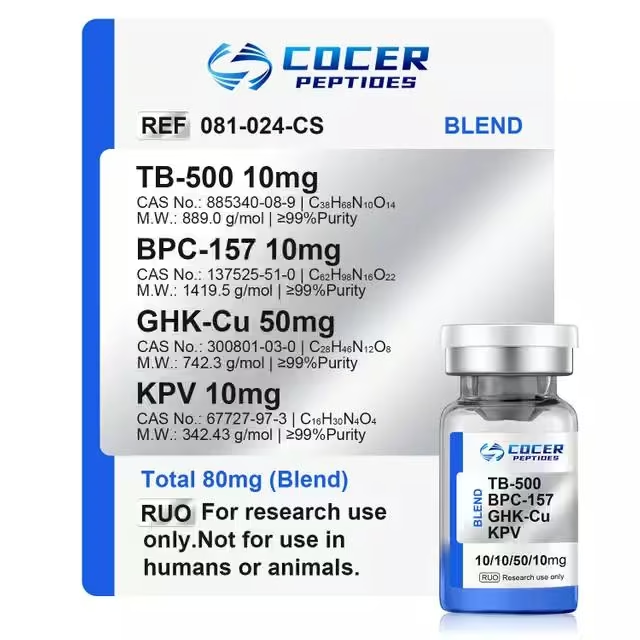
Klow Peptide 80mg
Original price was: £89.00.£84.00Current price is: £84.00.
🧬 Klow Peptide – 80mg Research Blend
-
🔬 Quad blend: GHK-Cu 50mg + BPC-157 10mg + TB-500 10mg + KPV 10mg
-
✅ ≥99% purity, HPLC tested
-
📦 80mg total peptide per vial
-
💧 Free bacteriostatic water with every order
-
🧪 For laboratory research only
Order now – premium Klow peptide blend! 🚀
15% DISCOUNT ON CHECKOUT WITH CRYPTO
- Satisfaction Guaranteed
- No Hassle Refunds
- Secure Payments
Description
Klow Peptide 80mg UK: Premium Multi-Peptide Research Blend for Regenerative Studies
Product Overview
The Klow peptide is a four-component research blend designed for laboratory investigation of tissue repair, inflammation modulation, and cellular regeneration pathways. This 80mg formulation combines GHK-Cu (50mg), BPC-157 (10mg), TB-500 (10mg), and KPV (10mg) into a single lyophilized vial. For researchers seeking a Klow peptide that covers multiple regenerative angles in one preparation, this blend offers documented composition and batch-specific analytical support.
The Klow peptide distinguishes itself from the three-peptide GLOW stack by the addition of KPV, an alpha-MSH-derived tripeptide studied for its role in inflammatory signalling and barrier function . This inclusion gives the Klow peptide an inflammation-focused research dimension that complements the repair-oriented components. Each peptide within the Klow peptide targets a distinct biological pathway: GHK-Cu for extracellular matrix and collagen-related research , BPC-157 for angiogenesis and tissue repair models , TB-500 for cell migration studies , and KPV for NF-κB pathway investigation .
Important Notice: The Klow peptide is supplied strictly for research purposes only and is not intended for human or veterinary use. No component of this blend holds MHRA marketing authorisation for human therapeutic applications. BPC-157 is listed on the WADA Prohibited List under class S0 (Non-Approved Substances), which is relevant for any research involving athletes .
Product Specifications
| Feature | Specification |
|---|---|
| Blend Components | GHK-Cu 50mg + BPC-157 10mg + TB-500 10mg + KPV 10mg |
| Total Peptide Content | 80mg per vial |
| GHK-Cu CAS | 89030-95-5 |
| BPC-157 CAS | 137525-51-0 |
| TB-500 CAS | 77591-33-4 |
| KPV CAS | 67727-97-3 |
| Purity | ≥99% (HPLC) |
| Form | Lyophilized powder |
| Storage | -20°C (long-term), protected from light |
| For Research Use Only | Not for human or veterinary use |
Mechanism of Action
GHK-Cu – Extracellular Matrix Research
GHK-Cu is a copper-binding tripeptide studied for its role in collagen gene expression regulation and extracellular matrix remodelling. According to the NCATS Inxight Drugs database, prezatide (GHK-Cu) increases the synthesis and deposition of type I collagen and glycosaminoglycan, and is thought to play a role in the modulation of tissue remodelling . Research models examine its effects on collagen I and III synthesis in fibroblast cultures. The copper component adds a consideration for copper metabolism in experimental design .
BPC-157 – Angiogenesis and Repair Models
BPC-157 is a synthetic pentadecapeptide studied for its interaction with VEGFR2 signalling and angiogenic pathways in endothelial cell models. A systematic review published in Sage Journals examined 36 preclinical studies and found that BPC-157 enhances growth hormone receptor expression and several pathways involved in cell growth and angiogenesis, while reducing inflammatory cytokines . Laboratory research examines its effects on fibroblast migration and growth factor signalling in tendon and ligament cell cultures.
TB-500 – Cell Migration Research
TB-500 (thymosin beta-4 fragment) is investigated for its role in cellular migration and tissue remodelling processes. According to research published in MDPI, the evidence base for TB-500 remains weighted toward preclinical studies, with direct TB-500 evidence limited to a single included study in a recent scoping review . Research models focus on actin cytoskeleton regulation and cell motility endpoints in vitro. The TB-500 component renders the Klow peptide prohibited under WADA S2 regulations .
KPV – Inflammatory Pathway Modulation
KPV is a tripeptide fragment of alpha-MSH studied for its interaction with NF-κB signalling. Research published in ScienceDirect demonstrated that KPV mitigates fine dust-induced keratinocyte apoptosis and inflammation by regulating oxidative stress and modulating the MAPK/NF-κB pathway . Additional research in NIH PubMed confirmed that immobilized GKPV peptide significantly inhibited NF-κB-luciferase activity, suggesting the carboxyl terminal MSH peptide acts via a cell receptor-based mechanism . The KPV component is the distinguishing feature of the Klow peptide relative to GLOW formulations.
Multi-Pathway Research Design
The Klow peptide enables investigation of four complementary biological mechanisms within a single experimental system. Research published in NIH PMC outlines distinct molecular pathways for each component: BPC-157 acts via PI3K/Akt, VEGF, eNOS, and TGF-β signalling; TB-500 via MAPK, NF-κB, and actin polymerization; and GHK-Cu via MMP regulation and the copper-redox axis . Researchers can compare the combined blend against individual component controls to characterise pathway crosstalk in tissue repair models.
Research Applications
Tissue Remodelling and Extracellular Matrix Research
The GHK-Cu component makes the Klow peptide relevant for studies examining collagen-related pathways and fibroblast activity. Research indicates that GHK-Cu accelerates degradation of supersized collagen and promotes synthesis of regular collagen, elastin, proteoglycans and glycosaminoglycans . Studies in this area focus on extracellular matrix composition and remodelling endpoints.
Inflammation and Barrier Function Studies
The KPV component positions the Klow peptide for research examining inflammatory signalling and epithelial barrier behaviour. Research in ScienceDirect demonstrated that KPV exhibits anti-inflammatory effects distinct from core MSH peptides, likely acting through inhibition of IL-1β functions rather than melanocortin receptors . Studies in this space investigate cytokine modulation and NF-κB pathway activity.
Cellular Repair and Angiogenesis Research
The BPC-157 component brings angiogenesis and vascular repair signalling into the Klow peptide research frame. Preclinical models often examine endothelial cell behaviour and capillary formation, with BPC-157 demonstrating improved functional, structural, and biomechanical outcomes in muscle, tendon, ligament, and bony injuries .
Cell Migration and Cytoskeletal Research
The TB-500 component supports research examining cell motility and actin dynamics. The peptide segment LKKTETQ is the active site within thymosin beta-4 responsible for actin binding, as documented in NIH PubMed . Endpoints typically include migration assays and cytoskeletal reorganisation measures.
Quality and Purity
Each batch of Cocer Peptides Klow peptide undergoes quality control aligned with research-grade standards:
-
≥99% purity verified by HPLC
-
Mass spectrometry identity confirmation for all four components
-
Batch/lot number matching the vial label
-
Certificate of Analysis (COA) available on request
Batch-level analytical documentation is essential when sourcing the Klow peptide. The Medicines and Healthcare products Regulatory Agency (MHRA) has warned against purchasing unlicensed medicines and research peptides online, noting that such products may be contaminated, mislabelled, or of unknown potency. Researchers should verify that each COA includes identity confirmation and individual component quantification for all four peptides.
Frequently Asked Questions
What is the Klow peptide?
The Klow peptide is a four-component research blend containing GHK-Cu, BPC-157, TB-500, and KPV. It is supplied as an 80mg lyophilized powder for laboratory research applications.
How does the Klow peptide differ from GLOW?
The Klow peptide adds KPV to the three peptides typically found in GLOW formulations. This addition provides an inflammation-focused research dimension that GLOW lacks .
What is the composition of the Klow peptide?
Each 80mg vial contains GHK-Cu (50mg), BPC-157 (10mg), TB-500 (10mg), and KPV (10mg).
Is the Klow peptide approved for human use?
No. The Klow peptide is supplied strictly for research purposes only. No component is approved for human or veterinary use. BPC-157 is prohibited under WADA S0 for athletes .
How should the Klow peptide be stored?
Store lyophilized powder at -20°C, protected from light and moisture. Reconstituted material should be used promptly following standard laboratory protocols.
What should I look for on a Klow peptide COA?
Look for batch-specific identity confirmation, purity ≥99%, individual component quantification for all four peptides, and lot traceability.
Conclusion
The Klow peptide 80mg blend represents a multi-target research tool for investigating tissue repair, inflammation modulation, and regenerative pathways. With its four-component composition of GHK-Cu, BPC-157, TB-500, and KPV, the Klow peptide enables researchers to study multiple biological mechanisms in a single preparation. For laboratories sourcing the Klow peptide, this formulation offers documented composition, ≥99% purity, and batch-specific analytical support.
Ready to Advance Your Research?
Order the Klow peptide 80mg research blend for your laboratory today.
Related products
-
Sale!
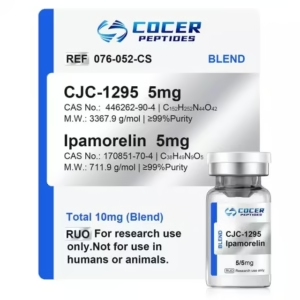
CJC-1295 Ipamorelin Blend
Price range: £83.00 through £135.00Select options This product has multiple variants. The options may be chosen on the product page -
Sale!
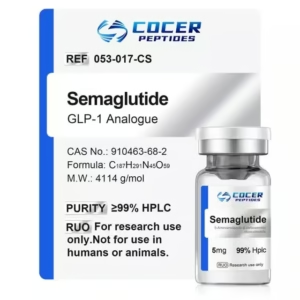
Semaglutide
Price range: £72.00 through £185.00Select options This product has multiple variants. The options may be chosen on the product page -
Sale!
-
Sale!
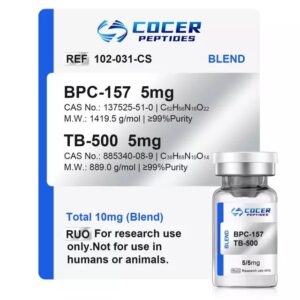
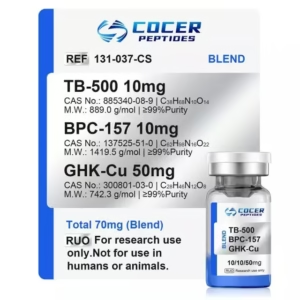
BPC 157 TB 500
Price range: £120.00 through £215.00Select options This product has multiple variants. The options may be chosen on the product page
Reviews
There are no reviews yet.