
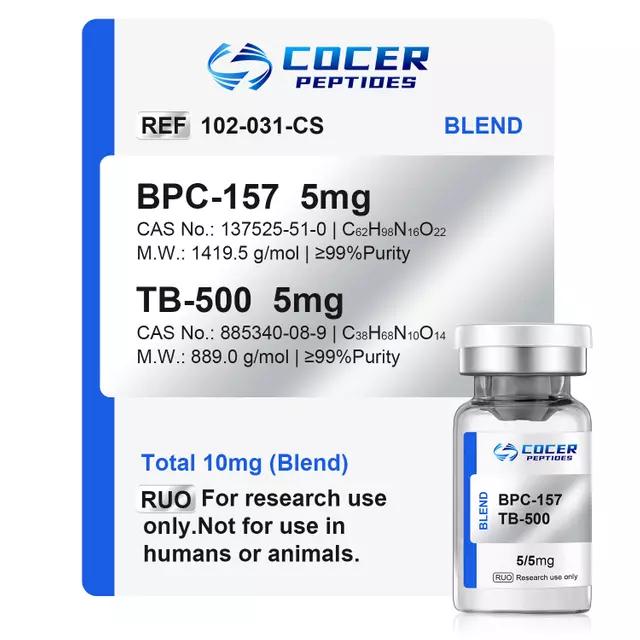
BPC 157 TB 500
Price range: £120.00 through £215.00
15% DISCOUNT ON CHECKOUT WITH CRYPTO
- Satisfaction Guaranteed
- No Hassle Refunds
- Secure Payments
Description
BPC 157 TB 500 – Research Grade Combination Peptide
Product Overview
The BPC 157 TB 500 combination pairs two extensively studied research peptides in a single formulation designed for laboratory investigation of tissue repair signalling pathways. BPC-157 is a synthetic 15-amino-acid pentadecapeptide derived from a protective protein found in human gastric juice, while TB-500 is a synthetic fragment corresponding to the active region of thymosin beta-4, a naturally occurring actin-binding protein, as documented by the IAPAM peptide reference library.
Researchers investigating BPC 157 TB 500 often do so because the two compounds target complementary mechanisms. BPC-157 is studied primarily through angiogenesis and collagen synthesis pathways, while TB-500 is associated with cellular migration and actin polymerisation, according to research published by Genetra UK. The mechanistic rationale for combining these peptides is that their complementary actions could produce additive effects on tissue repair processes—though this remains a hypothesis rather than a demonstrated outcome in controlled studies.
This BPC 157 TB 500 blend is supplied as a lyophilized powder for laboratory investigation. Each batch undergoes rigorous quality control to ensure purity and consistency.
Important Notice: This product is supplied strictly for research purposes only and is not intended for human or veterinary use. No human clinical trials have evaluated the BPC-157 and TB-500 combination for any indication, as confirmed by Peptide Insider. TB-500 is prohibited by the World Anti-Doping Agency (WADA) according to MY PEPTIDES. This product is not authorised by the MHRA as a medicine for human use.
Product Specifications
| Feature | Specification |
|---|---|
| Peptide Name | BPC 157 TB 500 Blend |
| Components | BPC-157 + TB-500 |
| BPC-157 Sequence | Gly-Glu-Pro-Pro-Pro-Gly-Lys-Pro-Ala-Asp-Asp-Ala-Gly-Leu-Val |
| TB-500 Sequence | Thymosin beta-4 fragment (17 amino acids) |
| Purity | ≥99% (HPLC) |
| Form | Lyophilized powder |
| Storage | -20°C (long-term), 2–8°C (reconstituted) |
| For Research Use Only | Not for human or veterinary use |
Mechanism of Action
BPC-157 – Angiogenic Signalling
BPC-157 exerts its effects through multiple pathways relevant to tissue repair. Research indexed by BenchChem has demonstrated that BPC-157 activates the VEGFR2-Akt-eNOS pathway, promoting angiogenesis through increased nitric oxide production. The peptide also modulates the FAK-paxillin pathway, which is critical for cell adhesion, migration, and survival in fibroblasts and other reparative cells. Additionally, BPC-157 has been shown to upregulate growth hormone receptor expression and activate JAK2 signalling, enhancing cellular response to growth hormone.
TB-500 – Actin Dynamics and Cell Migration
TB-500 functions through a distinct mechanism involving regulation of actin, a cytoskeletal protein essential for cell motility, as detailed by BenchChem. By modulating actin dynamics, TB-500 facilitates the migration of reparative cells to injury sites, supporting the early stages of tissue organisation. This actin-binding behaviour provides a complementary mechanism to BPC-157’s angiogenic and proliferative effects.
Combined Research Model
The combination of BPC-157 and TB-500 presents a dual-pathway research model for investigating tissue repair signalling. BPC-157 contributes to microenvironment stability and endothelial support, while TB-500 supports cytoskeletal readiness and cell migration. This complementary framework allows researchers to examine how multiple repair-related signals interact within a controlled experimental system.
It is important to note that no published study has directly compared the combination against either compound administered alone. The synergy claim is a reasonable hypothesis that remains untested in controlled research settings.
Research Applications
Tendon and Ligament Research
A 2026 study published in Joint Diseases and Related Surgery evaluated BPC-157 and TB-500 in a rat Achilles tendon healing model. The study found that both peptides were associated with improved histopathological parameters and extracellular matrix organisation. TB-500 demonstrated a significant biomechanical advantage at four weeks, with higher maximum load to failure values compared to controls. However, combined BPC-157 and TB-500 treatment did not confer additional benefits compared to either agent alone, suggesting possible convergence on shared downstream pathways.
Musculoskeletal Tissue Research
Research literature has explored BPC-157 in tendon, ligament, and gastrointestinal injury models, with consistent angiogenic activity reported across tissue types. TB-500 has been examined in wound, corneal, dermal, and cardiac models, with effects on cell migration and structural repair signalling. These complementary research areas support the combined investigation of both peptides.
Cellular Signalling Studies
The BPC 157 TB 500 combination enables investigation of multiple signalling pathways within a single experimental system. BPC-157’s effects on VEGFR2, FAK-paxillin, and growth hormone receptor pathways can be studied alongside TB-500’s actin-modulating effects. This allows researchers to examine potential cross-pathway interactions and convergent signalling responses.
Quality and Purity
Each batch of Cocer Peptides BPC 157 TB 500 undergoes rigorous quality control:
-
≥99% purity verified by HPLC
-
Mass spectrometry identity confirmation for both components
-
Batch/lot number matching the vial label
-
Certificate of Analysis (COA) available on request
Independent testing has revealed that approximately 30% of sampled peptide products from unregulated sources may have mislabeling, dosing errors, or contamination issues. For researchers sourcing BPC 157 TB 500, verifying COA documentation is essential for ensuring product integrity and experimental reproducibility.
The Medicines and Healthcare products Regulatory Agency (MHRA) has warned against purchasing unlicensed medicines and research peptides online, noting that such products may be contaminated, mislabelled, or of unknown potency.
Frequently Asked Questions
What is the BPC 157 TB 500 combination?
BPC 157 TB 500 is a research peptide blend containing two synthetic peptides: BPC-157 (a pentadecapeptide) and TB-500 (a thymosin beta-4 fragment). They are studied for their complementary mechanisms in tissue repair research.
What are BPC 157 TB 500 studied for?
Researchers investigate this combination for tendon, ligament, and connective tissue research models, cell migration and cytoskeletal organisation studies, and angiogenesis pathway research, as outlined by Genetra UK.
Is this product legal in the UK?
BPC 157 TB 500 is supplied strictly for in-vitro laboratory research use only. It is not a licensed medicine and is not authorised for human or veterinary use. Purchasers are responsible for ensuring compliance with applicable UK regulations, as noted by MY PEPTIDES.
What purity level can I expect?
Our BPC 157 TB 500 is provided at ≥99% purity, verified by HPLC with third-party testing.
How should BPC 157 TB 500 be stored?
Store lyophilized powder at -20°C for long-term stability. Reconstituted material should be stored at 2–8°C and used promptly following standard laboratory protocols.
Is this product suitable for human use?
No. This product is supplied strictly for research purposes only and is not intended for human or veterinary use. No human clinical trials have evaluated this combination, and the combined safety profile is essentially unknown, as confirmed by Peptide Insider.
Conclusion
The BPC 157 TB 500 combination represents a dual-pathway research tool for investigating tissue repair signalling mechanisms. With its high-purity formulation and comprehensive quality documentation, this blend enables researchers to study complementary angiogenic and cytoskeletal pathways in controlled laboratory settings. For UK laboratories sourcing BPC 157 TB 500 for research applications, this product offers documented composition, ≥99% purity, and batch-specific COA support.
Ready to Advance Your Research?
Order premium BPC 157 TB 500 for your laboratory today.
Additional information
| mg | 10/10mg, 5/5mg |
|---|
Related products
-
Sale!
Tesamorelin Peptide UK Ipamorelin Blend
Price range: £77.00 through £95.00Select options This product has multiple variants. The options may be chosen on the product page -
Sale!
Tesamorelin + CJC-1295 + Ipamorelin (6/3/3)mg
Original price was: £108.00.£95.00Current price is: £95.00. -
Sale!
CoreMend KPV, BPC 157 and TB 500 Blend
Original price was: £197.00.£174.00Current price is: £174.00. -
Sale!
Semax UK Pinealon/NA Selank/PE22- 28) 50mg Illumineuro Peptide
Original price was: £144.00.£135.00Current price is: £135.00.
Reviews
There are no reviews yet.