
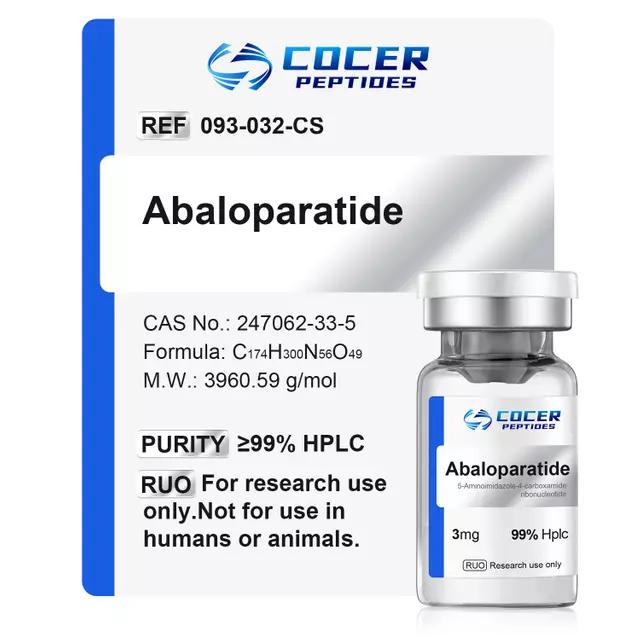
Abaloparatide 3mg (1kit 10 vials)
Original price was: £55.00.£45.00Current price is: £45.00.
Abaloparatide, a synthetic PTHrP analog, binds to PTH1R on osteoblasts. This activates the cAMP pathway, promoting osteoblast activity and inhibiting apoptosis. It also modulates osteoclast activity. This leads to increased bone formation over resorption, improving bone density, microarchitecture, and strength.
Description
Abaloparatide – Research-Grade PTHrP Analog for Bone Studies
Cocer Peptides is proud to offer Abaloparatide, a high-purity research-grade synthetic peptide analog of human parathyroid hormone-related protein (PTHrP 1-34).
With a molecular formula of C₁₇₄H₃₀₀N₅₆O₄₉ and a molecular weight of 3960.59 g/mol, this 34-amino-acid peptide represents a significant advancement in bone anabolic research.
First FDA-approved in 2017 under the brand name Tymlos for the treatment of osteoporosis in postmenopausal women at high risk of fracture, this compound has since become a benchmark for investigating PTH1R-mediated bone formation pathways in laboratory settings.
⚠️ Important Notice: This product is supplied for laboratory research use only. It is not intended for human or veterinary consumption and must not be used in clinical or therapeutic applications.
As a research peptide, this compound provides scientists with a reliable tool for investigating osteoanabolic signalling pathways, bone remodelling dynamics, and potential applications in bone regeneration research.
The compound is of particular interest to researchers studying the molecular mechanisms underlying PTHrP receptor activation and its effects on osteoblast activity.
The National Institutes of Health maintains extensive databases on PTHrP research, and investigations into this peptide continue to expand our understanding of bone biology.
Research published in peer-reviewed journals and documented in the PubMed database has explored the biochemical properties and potential research applications of this peptide.
The Google Scholar database provides access to thousands of citations on PTHrP and peptide research.
Meanwhile, ScienceDirect and ResearchGate offer additional resources for researchers exploring bone anabolic pathways.
What Is Abaloparatide?
This compound is a synthetic recombinant peptide comprising 34 amino acids with the sequence Ala-Val-Ser-Glu-His-Gln-Leu-Leu-His-Asp-Lys-Gly-Lys-Ser-Ile-Gln-Asp-Leu-Arg-Arg-Arg-Glu-Leu-Leu-Glu-Lys-Leu-Leu-Aib-Lys-Leu-His-Thr-Ala.
It is a structural analog of the biologically active N-terminal fragment of human parathyroid hormone-related protein (PTHrP 1-34), sharing 20 of its 34 amino acid residues with PTHrP.
Structure and Composition:
| Property | Specification |
|---|---|
| Product Name | Abaloparatide |
| Molecular Formula | C₁₇₄H₃₀₀N₅₆O₄₉ |
| Molecular Weight | 3960.59 g/mol |
| Exact Mass | 3958.2705 |
| Sequence | AVSEHQLLHDKGKSIQDLRRRELLEKLLXKLHTA (34 aa) |
| Research Area | Bone Biology, Osteoporosis |
While teriparatide (PTH 1-34) and this compound both act through the parathyroid hormone receptor type 1 (PTH1R), they elicit distinct signalling responses.
Teriparatide has higher affinity for the R0 conformation of PTH1R, producing high and sustained cAMP levels that stimulate both bone formation and resorption.
In contrast, this compound preferentially binds to the RG conformation, inducing lower and shorter-lived cAMP signalling that promotes a more favourable balance toward bone formation over resorption.
This differential receptor binding—documented in research available through ScienceDirect—is the basis for its wider “anabolic window” and potentially superior effects on cortical bone.
Chemical and Structural Properties
Molecular Characteristics
| Property | Specification |
|---|---|
| Product Name | Abaloparatide |
| Molecular Formula | C₁₇₄H₃₀₀N₅₆O₄₉ |
| Molecular Weight | 3960.59 g/mol |
| Sequence | 34 amino acids (PTHrP 1-34 analog) |
| Purity | ≥98% (HPLC verified) |
| Form | Lyophilised Solid |
| Research Area | Bone Biology, Osteoporosis |
The structure of this peptide has been extensively characterised through analytical techniques including mass spectrometry and HPLC.
The peptide contains key substitutions that differentiate it from PTHrP, particularly between positions 22–34, which contribute to its unique receptor binding profile.
These structural modifications—accessible via the NIH chemical database—enable faster dissociation from PTH1R than parathyroid hormone, resulting in fewer adverse effects, notably reduced hypercalcemia and bone resorption.
The peptide is manufactured as a lyophilised solid, a drying process that preserves structural integrity and ensures stability during storage.
This form allows researchers to reconstitute the peptide at desired concentrations for specific assay requirements.
Purity and Quality Standards
This compound is manufactured to meet research-grade specifications with a guaranteed purity of ≥98% verified by High-Performance Liquid Chromatography (HPLC).
This level of purity is essential for research applications where contaminant interference could compromise experimental validity.
Independent batch testing is conducted to verify:
-
Peptide identity and sequence confirmation
-
Purity verification via HPLC
-
Residual solvent analysis
-
Endotoxin testing (where applicable)
Researchers can access the Certificate of Analysis (COA) for each batch, providing full transparency on product quality and testing parameters.
Research Applications
Bone Formation and Osteoporosis Research
The primary research interest in this compound centres on bone formation studies and osteoporosis models.
As a PTHrP 1-34 analog, it is studied for its potential influence on:
-
Osteoblast differentiation and activity
-
Trabecular bone architecture
-
Cortical bone remodelling
-
Bone mineral density modulation
Research into peptide regulation of bone formation remains an active area of investigation, with numerous studies indexed on PubMed and ResearchGate.
The mechanism of action involves binding to PTH type 1 receptors (PTH1R) on osteoblasts and osteocytes, activating Gs-mediated adenylate cyclase pathways.
As noted in the Elsevier clinical review, PTHrP and this compound preferentially bind to the RG conformation of PTH1R, inducing cAMP production solely via membrane Gαs activation.
This results in lower and shorter-lived cAMP levels, reducing downstream PKA effectors including c-Fos, CREB, and RANKL.
This selective activation creates a more favourable balance toward bone formation over resorption.
Intermittent exposure preferentially stimulates osteoblastic bone formation over osteoclastic resorption, creating what researchers term the “anabolic window”.
Network meta-analyses published in Osteoporosis International and indexed on ScienceDirect have demonstrated advantages over teriparatide for non-vertebral fractures (OR: 0.87, 95% CI: 0.80–0.95) and hip fractures (OR: 0.81, 95% CI: 0.71–0.93).
While these findings are from clinical contexts, they inform the research applications of the peptide in laboratory settings.
Alveolar Bone and Craniofacial Research
Recent research has explored this peptide’s potential in alveolar bone augmentation and craniofacial studies.
A study published in the International Journal of Oral Science demonstrated that local submucosal injection combined with mechanical force promotes alveolar bone thickening through periosteal osteogenesis.
The research revealed several key findings accessible via ResearchGate :
-
Periosteal stem cell activation: The peptide enhances proliferation, migration, and FAK phosphorylation in periosteal stem cells
-
Mechano-dependent effects: Mechanical force is indispensable for the ossification process, with local injection alone promoting cell proliferation and collagen synthesis but not ossification
-
FAK pathway mediation: Focal adhesion kinase (FAK) mediates the pro-osteogenic effects, with FAK inhibition completely blocking peptide-induced bone formation
-
Site-specific responses: The peptide differentially promotes bone augmentation depending on anatomical site and mechanical loading conditions
These findings suggest that this compound combined with mechanical force represents a promising approach for drug-induced in situ alveolar bone augmentation, holding significant potential in dentistry research.
Bone Metastasis Research
This compound has been investigated in the context of bone metastasis research, particularly in breast cancer models.
A commentary published in JBMR Plus examined preclinical findings demonstrating that this peptide increases bone formation in murine models of breast cancer bone metastases without enhancing tumour growth.
The research, accessible via the Mayo Clinic research portal and PubMed, reviewed historical concerns over PTH/PTHrP analogs and tumour progression.
While the findings suggest that bone anabolic strategies may safely improve skeletal health for patients with bone metastases, the authors emphasise the need for further research in more clinically relevant settings, including appropriate immunocompetent models.
Comparative Bone Anabolic Research
This peptide serves as a valuable tool for comparative bone anabolic research, enabling investigations into:
-
PTH vs PTHrP signalling pathways
-
Receptor conformation preferences
-
Anabolic window optimisation
-
Cortical vs trabecular bone effects
Histological assessments in rodent models have demonstrated that this compound acts similarly to teriparatide through PTH1R but may have a wider anabolic window due to its lesser impact on bone resorption.
According to research published in the Journal of Bone and Mineral Metabolism and indexed on Google Scholar, peptide-induced bone formation cannot be explained solely by remodelling-based bone formation.
This indicates the need for further research into modelling-based bone formation, underscoring the unique research value of this compound as a tool for investigating distinct bone formation mechanisms.
Ovariectomy-Induced Bone Loss Research
Studies in ovariectomised mouse models have demonstrated that this compound suppresses bone loss following ovariectomy by promoting both remodelling-based and modelling-based bone formation.
Research published in the Journal of Oral Biosciences employed histochemical assessment to characterise the anabolic effects on femoral metaphyses of ovariectomised mice.
Micro-CT imaging and histochemical staining—methodologies detailed in ScienceDirect—revealed that treatment maintained trabecular number and bone volume to six weeks post-ovariectomy.
ALP-positive osteoblastic cells surrounded the trabeculae, with long lines of PHOSPHO1-reactive mature osteoblasts expanding to the terminal region of the trabeculae.
Long continuous calcein labelling on slightly convex new bone indicated modelling-based bone formation.
Technical Specifications
| Specification | Detail |
|---|---|
| Product Name | Abaloparatide |
| Molecular Weight | 3960.59 g/mol |
| Molecular Formula | C₁₇₄H₃₀₀N₅₆O₄₉ |
| Sequence | 34 amino acids (PTHrP 1-34 analog) |
| Purity | ≥98% (HPLC) |
| Form | Lyophilised Solid |
| Research Areas | Bone Biology, Osteoporosis |
| Storage | 2–8°C |
Reconstitution and Handling Protocol
Recommended Storage Conditions
This compound is supplied as a lyophilised solid and should be stored at 2–8°C to maintain stability and potency.
Proper temperature control prevents degradation and preserves the peptide’s structural integrity.
-
Short-term storage: 2–8°C (refrigeration)
-
Long-term storage: -20°C or below (freezer)
-
Protect from light: Store in original packaging or dark conditions
-
Do not freeze: After reconstitution, avoid repeated freeze-thaw cycles
Reconstitution Guidelines
For best results in a research setting, allow both the peptide and chosen solvent to reach ambient laboratory temperature before reconstitution.
This helps maintain structural integrity during dissolution.
Standard reconstitution protocol:
-
Bring lyophilised peptide and solvent to room temperature
-
Add the appropriate volume of sterile solvent (water for injection, PBS, or bacteriostatic water)
-
Gently swirl—do not vortex or shake vigorously
-
Allow to fully dissolve before use
-
Use within the recommended timeframe
Dissolved solutions should be aliquoted and stored at -20°C to avoid repeated freeze-thaw cycles, and are best used fresh after preparation.
Quality Assurance and Testing
Cocer Peptides is committed to providing research-grade compounds that meet the highest standards of quality and consistency.
Each batch undergoes rigorous testing to verify:
-
Identity confirmation: Mass spectrometry verification
-
Purity analysis: HPLC with ≥98% purity threshold
-
Content uniformity: Consistency across vials
-
Residual solvent analysis: Within acceptable limits
Independent third-party testing is conducted to ensure unbiased verification.
Researchers can view the Certificate of Analysis for their specific batch directly on our site, providing full transparency and traceability.
Frequently Asked Questions (FAQ)
What is Abaloparatide?
This compound is a synthetic 34-amino-acid peptide analog of human parathyroid hormone-related protein (PTHrP 1-34).
It is FDA-approved for clinical use in osteoporosis treatment and is a valuable research tool for investigating bone anabolic pathways.
Comprehensive research on PTHrP analogs is available through PubMed and Google Scholar.
What is the purity of Abaloparatide?
This compound is guaranteed to have a purity of ≥98% verified by HPLC testing.
Each batch is independently tested to ensure quality and consistency.
How should Abaloparatide be stored?
This compound should be stored at 2–8°C as a lyophilised solid.
After reconstitution, it should be refrigerated and used within the recommended timeframe to maintain stability.
What research applications is Abaloparatide used for?
This compound is used in research exploring bone formation, osteoporosis mechanisms, alveolar bone augmentation, bone metastasis, PTH1R signalling pathways, and modelling-based bone formation.
For a comprehensive overview of peptide research applications, researchers are encouraged to explore the PubMed database, which indexes thousands of studies on PTHrP and peptide research.
ScienceDirect and ResearchGate offer additional resources for researchers exploring bone anabolic pathways.
How should I reconstitute Abaloparatide?
Allow both the peptide and solvent to reach room temperature before reconstitution.
Add the appropriate volume of sterile solvent and gently swirl to dissolve.
Do not vortex or shake vigorously.
Is Abaloparatide approved for human use?
No. This compound is strictly for laboratory research use only and is not approved for human or veterinary use as a research product.
This product must not be used in clinical or therapeutic applications.
Conclusion
Abaloparatide (PTHrP 1-34 analog) represents a powerful research tool for scientists investigating bone biology, osteoporosis mechanisms, alveolar bone augmentation, and PTH1R signalling pathways.
With a molecular weight of 3960.59 g/mol and guaranteed purity of ≥98%, this synthetic peptide offers the consistency and reliability required for reproducible research outcomes.
The peptide’s demonstrated effects in bone formation studies, alveolar bone research, bone metastasis models, and comparative PTH/PTHrP investigations make it a versatile tool for laboratory research.
Research published in peer-reviewed journals and documented in the PubMed database has explored the biochemical properties and potential research applications of this peptide.
The Google Scholar database provides access to thousands of citations on PTHrP and peptide research.
Meanwhile, ScienceDirect and ResearchGate offer additional resources for researchers exploring bone anabolic pathways.
As with all research peptides, this compound is intended for laboratory use only and should be handled according to established protocols for peptide-based research.
Cocer Peptides is proud to provide UK researchers with access to high-quality, independently tested research compounds.
Related Research Products
-
Bioregulator Peptides – View our complete bioregulator collection
-
Certificate of Analysis – Access batch-specific COA data
-
Research Peptides – Explore our full peptide catalogue
-
Reconstitution Guide – Comprehensive handling protocols
-
Contact Us – For research support and enquiries


Reviews
There are no reviews yet.